

By Mawa Kumaliopa
Malawi is emerging as one of the most expensive countries for fuel within the Southern African Development Community (SADC), a development that is intensifying pressure on households, businesses, and the broader economy. Recent comparative data shows a stark disparity between Malawi and its regional peers, prompting renewed scrutiny of the country’s fuel pricing structure and policy framework.
Widening Regional Gap
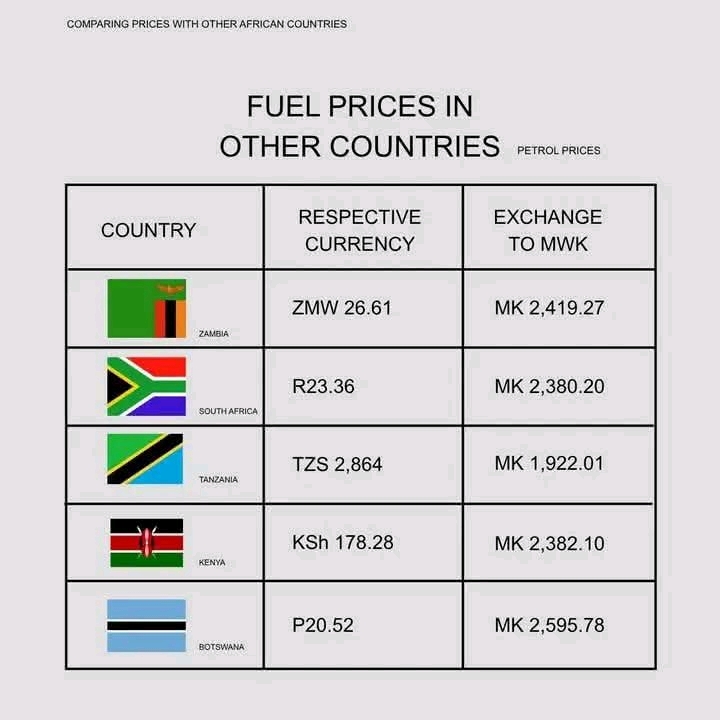
Current estimates indicate that fuel in Zambia is retailing at approximately MWK 2,419 per litre, significantly lower than Malawi’s prevailing pump price of around MWK 6,600 per litre. This means Malawians are paying nearly three times more for fuel than consumers in a neighboring country—an imbalance that is difficult to justify purely on market fundamentals.
Across SADC, several countries continue to maintain relatively moderate fuel prices due to more stable foreign exchange reserves, diversified energy sources, and, in some cases, government subsidies. Malawi, by contrast, remains heavily exposed to external shocks, particularly due to its reliance on imported fuel.
Structural Drivers Behind High Prices
At the core of Malawi’s fuel pricing challenge is its near-total dependence on imports. Without domestic refining capacity or significant fuel reserves, the country is vulnerable to global oil price volatility and exchange rate fluctuations. The scarcity of foreign currency further complicates procurement, often leading to supply bottlenecks and increased landing costs.
Taxation is another critical factor. Fuel in Malawi is subject to multiple levies and duties, which significantly inflate the final pump price. While these taxes are an important revenue stream for the government, critics argue they are disproportionately high compared to regional standards.
Additionally, inefficiencies within the fuel supply chain—including transportation logistics, storage limitations, and procurement systems—add further costs. Malawi’s landlocked geography compounds these challenges, as fuel must be transported over long distances through neighboring countries, increasing freight and insurance expenses.
Economic and Social Impact
The implications of persistently high fuel prices are far-reaching. Economists warn that elevated energy costs are a key driver of inflation, as they directly affect the price of goods and services across the economy. Transport costs rise, production becomes more expensive, and businesses are forced to pass these costs on to consumers.
For ordinary Malawians, the impact is immediate and severe. High fuel prices translate into increased public transport fares, higher food prices, and reduced disposable income. This exacerbates poverty levels and undermines living standards, particularly for low-income households.
From a competitiveness standpoint, Malawi risks losing its edge in regional trade. Industries face higher operational costs compared to counterparts in countries like Zambia and Tanzania, making locally produced goods less competitive both domestically and in export markets.
Growing Calls for Reform
The widening price gap has triggered calls for urgent policy intervention. Economic analysts are advocating for a comprehensive review of the fuel pricing mechanism, including taxation policies and procurement strategies. There is also increasing pressure on authorities to improve foreign exchange management and explore alternative energy solutions to reduce dependence on imported fuel.
Some stakeholders have proposed the adoption of more efficient bulk procurement systems, investment in fuel storage infrastructure, and regional cooperation in energy supply. Others argue for the introduction of targeted subsidies or tax relief measures to cushion consumers and businesses from the high cost burden.
Policy Crossroads
Malawi now faces a critical policy crossroads. Without decisive action, high fuel prices could continue to fuel inflation, suppress economic growth, and deepen social inequality. Aligning fuel costs more closely with regional benchmarks will require not only technical adjustments but also political will and long-term strategic planning.
As pressure mounts from both consumers and industry players, the government’s response in the coming months will be crucial in determining whether Malawi can regain stability and competitiveness within the SADC region.
MALAWI
FREEDOM
NETWORK
United for Freedom, Justice and a Better Malawi
Airtel Money
0994095804
Mpamba
0881428759
FDH Bank
Acc No:
1400000670385NBS Bank
Acc No:
10118988Thank you for your support!