By Mabvuto Kalawa
Correspondent, Malawi Freedom Network
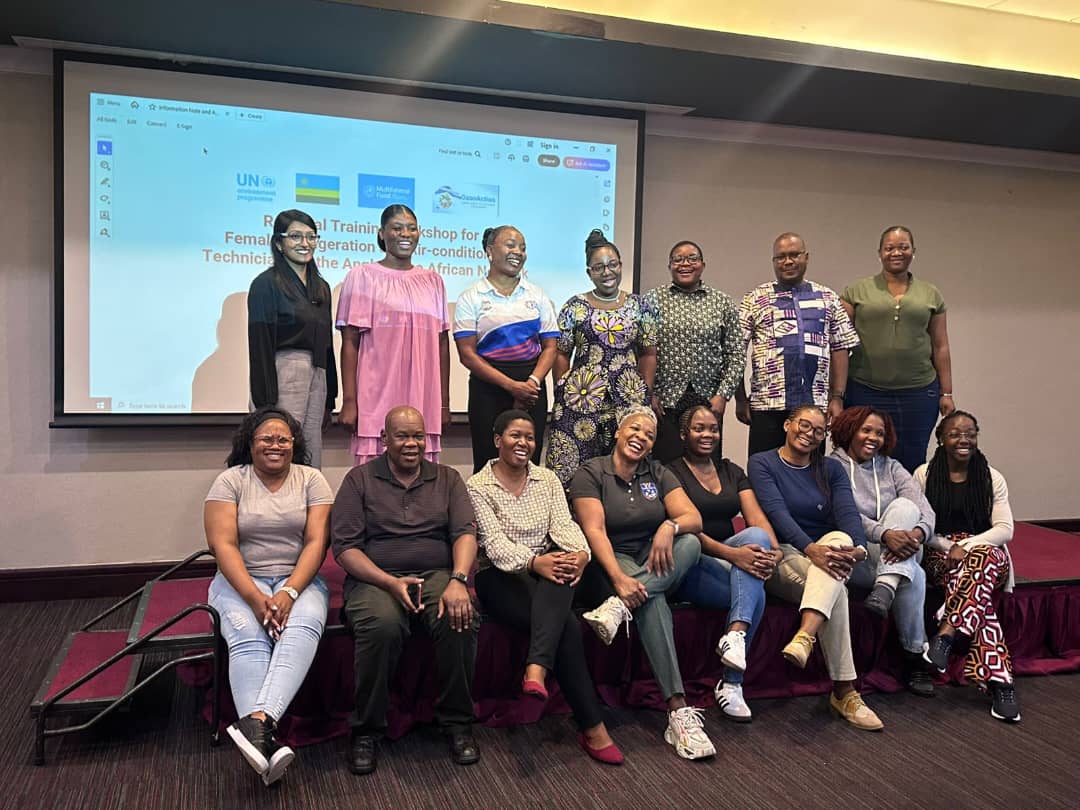
Two Malawian female professionals in refrigeration and air conditioning were among participants who attended a regional training workshop held in Kigali, Rwanda, aimed at empowering women in the refrigeration and cooling sector.
The training, which took place from 12 to 16 December 2025, was organized and fully funded by the United Nations Environment Programme (UNEP) under its agenda to promote gender equality in male-dominated professions.
The workshop brought together women professionals from several African countries, including Malawi, Ghana, Nigeria, Kenya, Tanzania, Uganda, The Gambia, Mauritius, Zambia, and Namibia, all of which are member states of the UNEP Africa Chapter.
Officially opening the training, Omar Abdelaziz, a UNEP representative, encouraged women participants to actively engage in the course in order to strengthen their knowledge and confidence in refrigeration and air-conditioning technologies.
Abdelaziz acknowledged that refrigeration and air conditioning remains a male-dominated field but urged women not to be intimidated, instead encouraging them to work hard, excel, and even surpass their male counterparts.
He emphasized that empowering women in technical professions is a key priority of the United Nations and an important step toward inclusive and sustainable development.
The primary objective of the training was to enhance women’s skills and technical knowledge in refrigeration and cooling, while promoting their increased participation in the industry across Africa.
The course also aimed to deepen participants’ understanding of sustainable and climate-friendly cooling practices.
During the workshop, participants received training in several key areas, including Minimum Energy Performance Standards (MEPS), certification schemes, energy-efficient equipment (Triple-E standards), climate-friendly cooling technologies, and sustainable refrigeration practices.
Additional sessions focused on fostering networking and collaboration among women professionals, as well as discussing challenges and success stories faced by women in the refrigeration and air-conditioning industry.
Commenting on the training, Mrs. Chimwemwe Chibowa of Malawi, one of the participants and an employee of Castel (Malawi) Limited, described the course as highly beneficial.
She said the training had significantly enhanced her technical knowledge and practical skills in refrigeration and cooling.
Mrs. Chibowa stated that she intends to apply the knowledge gained both at her workplace and at national level to help improve the lives of women in the profession.
She encouraged fellow women working in refrigeration and air conditioning not to feel ashamed of the trade but to be proud of their skills and contribution.
She also urged young girls with an interest in technical professions not to be discouraged, emphasizing that the field is rewarding and no longer reserved for men.
Addressing parents, Mrs. Chibowa called on them to support their daughters who wish to pursue careers in refrigeration and air conditioning, saying outdated perceptions about the profession should be abandoned.
She noted that through her profession she has been able to support her family and relatives, demonstrating the economic empowerment potential of technical skills.
Mrs. Chibowa further thanked Mrs. Mary Kapete, Malawi’s Ozone Officer, for selecting her to participate in the training.
On her part, Mrs. Mary Kapete, who served as a facilitator at the workshop, expressed gratitude to UNEP for including Malawian participants in the programme.
She told this reporter that she was impressed by the active participation and enthusiasm displayed by women throughout the training.
The facilitators for the workshop came from UNEP and the International Networking of Women in Construction (INWIC), an organization of which Malawi is a member.
The Kigali training was a follow-up to the Kairo 2023 training that was previously conducted in Kenya.
This year’s training was held under the theme “If You Don’t Go for It, You Can’t Have It.”
The workshop concluded with renewed commitment among participants to promote gender inclusion, sustainable cooling, and climate-friendly technologies across Africa.