By Contributor
What was constitutionally designed to be a professional, neutral, and citizen-serving law enforcement institution was, by multiple insider accounts, systematically hollowed out and repurposed into a political tool. Under the Malawi Congress Party (MCP) administration, the Malawi Police Service—particularly in Lilongwe and Blantyre—was allegedly reduced from guardian of public order to silent accomplice in orchestrated violence.
First-hand testimonies from serving police officers, speaking on condition of anonymity for fear of reprisals, describe a force compromised at command level and openly subordinated to partisan interests. Officers deployed during demonstrations say they were given explicit, non-negotiable instructions from their superiors—orders that had nothing to do with crowd control or public safety.
The directive, officers say, was chillingly precise.
“When protesters reached a certain point,” one officer revealed, “we were told party guys would emerge—armed—to infiltrate and inflame the situation. Our job was to do nothing. We were warned not to interfere.”
In plain terms, police officers were ordered to stand down while violence was unleashed in full view of the public. Law enforcement did not fail. It was deliberately switched off.
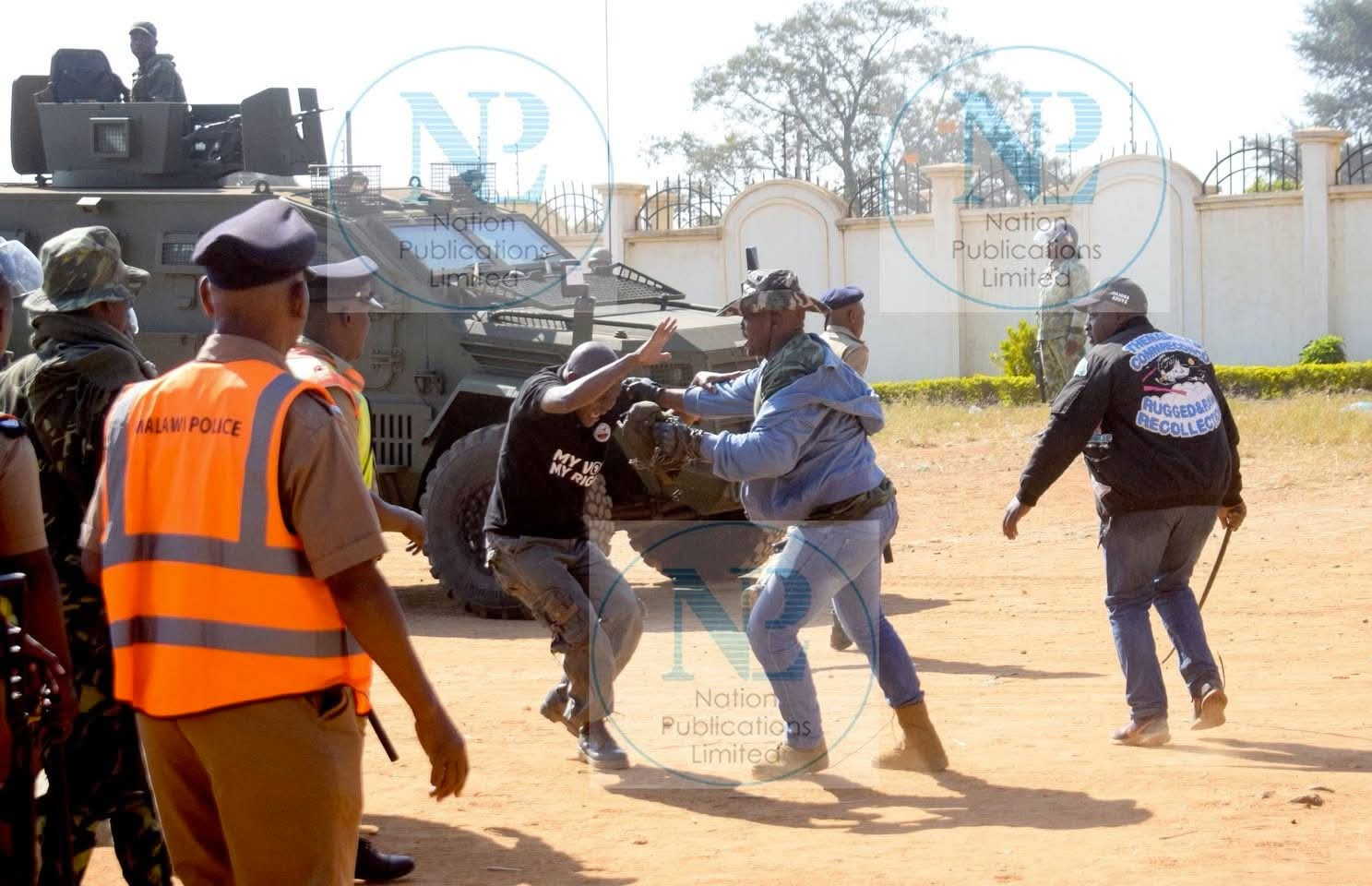
One officer recounted the now-notorious incident involving then Centre for Democracy and Economic Development Initiatives (CDEDI) director Sylvester Namiwa, who was brutally attacked by armed men during a protest. Acting on training and instinct, the officer attempted to intervene.
“I thought I was doing my job,” the officer said. “Stopping an assault. Protecting a civilian.”
That decision nearly ended his career.
His immediate superior reportedly reacted with fury—not because force had been used unlawfully, but because the officer had violated an unspoken political order. Only later did the officer learn the truth: the attackers were never meant to be stopped.
Back at the station, disciplinary action followed. The charge was not misconduct. It was disobedience—disobedience to political instructions masquerading as operational command. For the officer, that moment marked the death of professionalism within the service.
Even more disturbing are allegations that known MCP supporters were issued police uniforms on protest days. Officers say this was no accident. The uniforms served two purposes: intimidation of demonstrators and insulation of perpetrators from accountability.
“When violence happened,” one officer explained, “you could not tell who was real police and who was party militia. That confusion was intentional.”
Similar testimonies from Blantyre paint the same picture. Officers describe a policing environment where MCP loyalists were effectively untouchable—immune from arrest even when caught in clear violation of the law.
“We stopped being police officers,” one Blantyre-based officer said. “We became party cadres in uniform.”
According to these accounts, civilians were routinely transported to demonstrations not to express dissent, but to disrupt it—to provoke chaos, delegitimise genuine grievances, and justify heavy-handed narratives. The police, stripped of autonomy, were ordered to watch. The streets descended into fear, while public confidence in law enforcement collapsed.
This was not operational failure. It was not poor training or lack of resources. It was the deliberate institutionalisation of mediocrity and obedience, enforced from the top down. Political loyalty mattered more than competence. Allegiance to party interests outweighed loyalty to the Constitution.
A police service that applies the law selectively is no longer a service. It is a weapon.
Malawi paid a heavy price for allowing its law enforcement institutions to be dragged into partisan battles. Communities were terrorised. Dissent was criminalised. Trust—once broken—proved difficult to rebuild.
The unresolved question is whether the damage truly belongs to the past. Have the command structures been cleansed of political interference, or do the ghosts of that era still sit quietly in offices of authority, waiting for the next order from “above”?
Until that question is answered honestly, Malawi’s democracy remains exposed—and its police service remains on trial in the court of public conscience.