
By Contributor
At moments of national crisis, leadership is tested not by speeches, but by choices—especially the courage to accept accountability. The events surrounding former Minister of Finance Sosten Gwengwe in December 2022 expose a troubling culture at the heart of Malawi’s governance: a system that prioritizes political convenience over ethical responsibility and national interest.
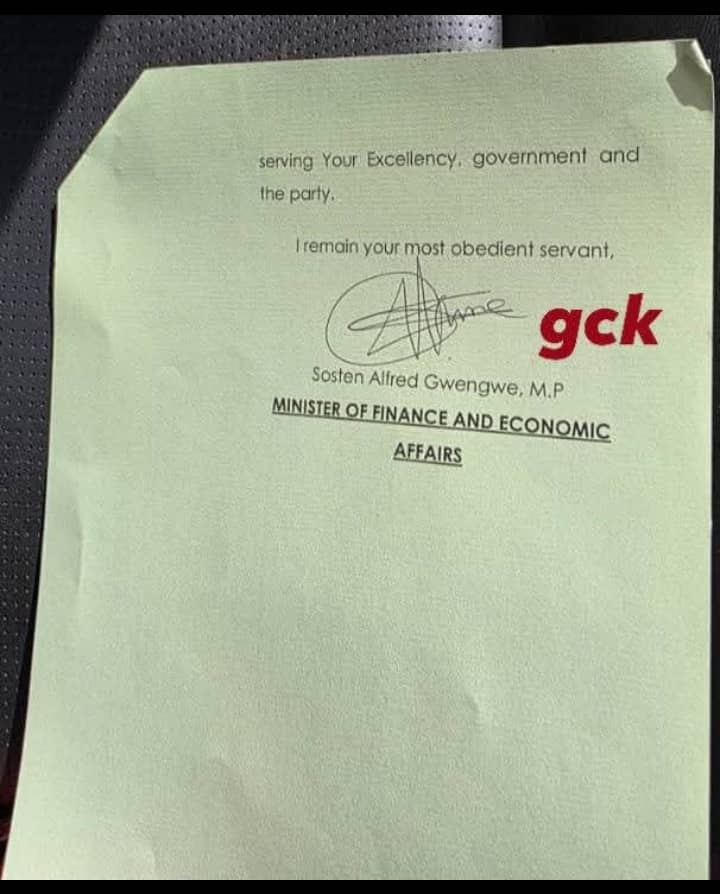
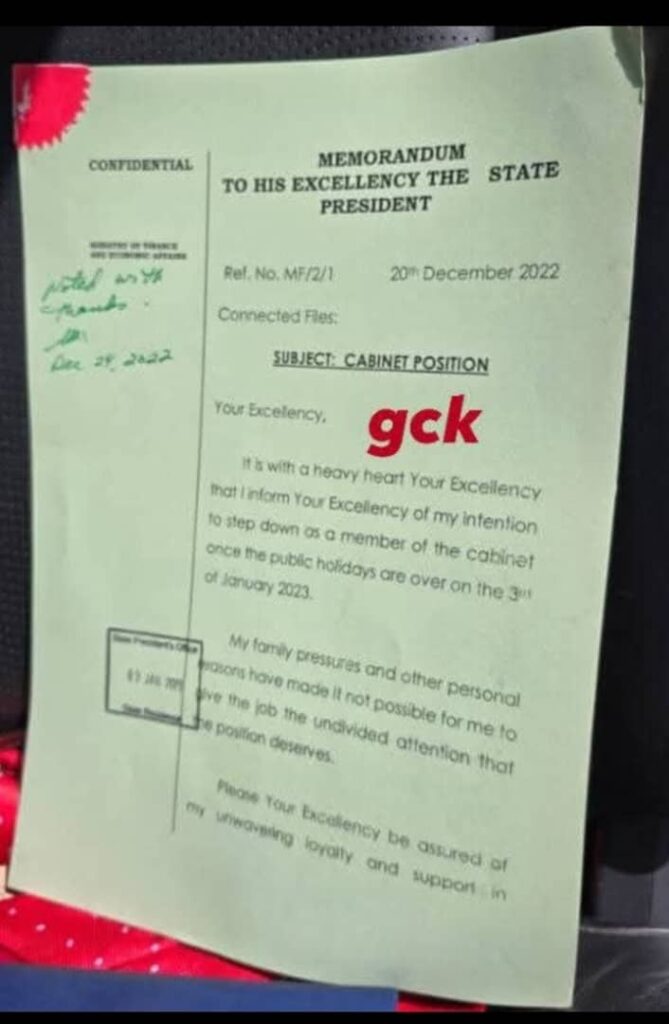
As internal pressure mounted within government—pressure reportedly driven by demands to craft policies that benefited a powerful few rather than the broader population—Sosten Gwengwe took a step that is rare in Malawian politics. On 20 December 2022, he formally wrote to President Lazarus McCarthy Chakwera, tendering his resignation as Minister of Finance. This was not an act of weakness; it was an implicit admission that the office had become compromised.
In mature democracies, such a move would be welcomed as a sign of integrity. A finance minister who feels constrained, undermined, or forced to act against the public interest steps aside to protect the credibility of both the office and the country. But Malawi’s political culture chose a different path.
Gwengwe’s resignation was rejected outright.
Rather than allowing accountability to take its course, the leadership opted for damage control. He was instructed to remain in Cabinet and later reassigned to another ministry. The message was unmistakable: positions matter more than principles, and the appearance of stability is valued over genuine reform.
More concerning is the timing. Gwengwe was retained long enough to conclude negotiations with the International Monetary Fund on the Extended Credit Facility (ECF)—a critical agreement that came with painful austerity measures for ordinary Malawians. Once the IMF deal was secured, the long-anticipated reshuffle followed.
This sequence of events raises uncomfortable questions. Was the national interest truly the guiding principle, or was Gwengwe kept in place simply to finish a task deemed politically and technically convenient? If internal pressures were already distorting decision-making, can Malawians be confident that those IMF negotiations were conducted in a fully transparent and independent manner?
The refusal to accept a resignation under such circumstances undermines public trust. It signals that Cabinet positions are not about service, but about control. It also reinforces a dangerous precedent: that even when a minister acknowledges untenable conditions, the system will protect itself rather than confront its failures.
Malawi today is grappling with rising poverty, a cost-of-living crisis, and deep public frustration. Citizens are told to tighten their belts while political elites reshuffle seats at the top with little regard for accountability. The Gwengwe episode is not an isolated incident—it is a symptom of a governance culture that resists self-correction.
If Malawi is serious about reform, it must start by respecting the very acts that demonstrate responsibility. Rejecting a resignation offered on principle is not leadership. It is denial.
And denial, as history repeatedly shows, is far more costly to a nation than the truth.