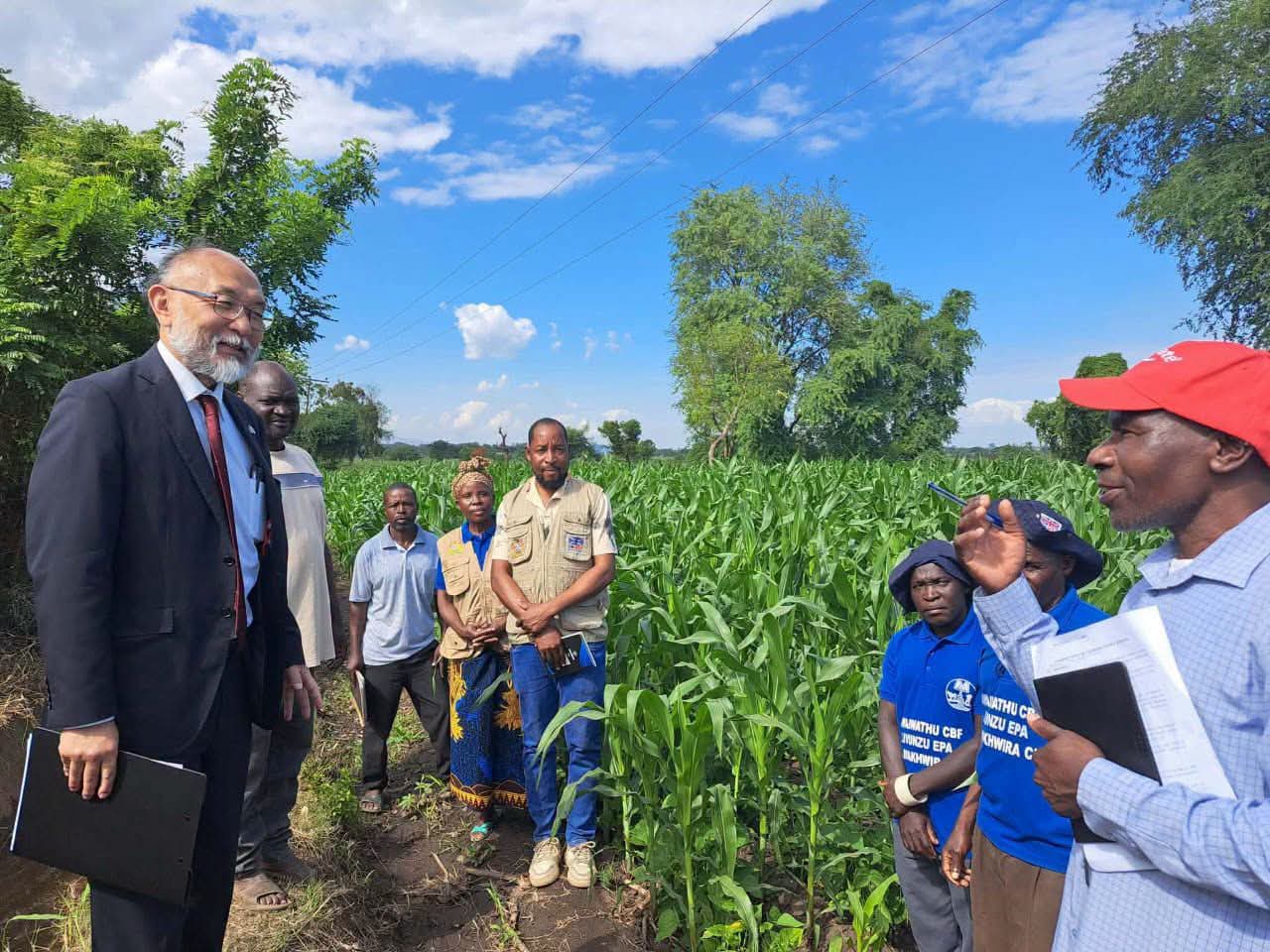
Malawi has been urged to accelerate investment in irrigation and climate-resilient agriculture as a lasting solution to the country’s recurring food insecurity, with the Japanese government emphasizing that sustainable food production is the key to reducing dependence on emergency food aid.
Japanese Ambassador to Malawi, Naito Yasushi, made the remarks during a recent visit to beneficiaries of a Japanese-funded resilience project in Chikwawa District, where he stressed that while humanitarian food assistance remains important during times of crisis, long-term food security can only be achieved by empowering communities to produce enough food for themselves.
Yasushi said Japan has consistently supported Malawi’s food security initiatives through food assistance delivered by the World Food Programme (WFP). However, he noted that the country’s future depends on strengthening agricultural productivity through reliable irrigation systems and climate-smart farming methods.Japan Ambassador Exposes MCP Campaign Pressure
“Food aid can alleviate food shortages, but what is important is supporting communities to produce more so that they become self-reliant,” said Yasushi.
The ambassador observed that climate change continues to pose serious challenges to Malawi’s agricultural sector, making it increasingly difficult for farmers who rely solely on rainfall. He said expanding irrigation infrastructure would help communities maintain food production even during prolonged dry spells and unpredictable weather conditions.
The resilience project in Chikwawa is being implemented by the Food and Agriculture Organisation (FAO) with financial support from the Government of Japan. The initiative aims to strengthen communities’ ability to withstand climate-related shocks while improving agricultural productivity and household food security.
According to Yusuf, rainfall patterns have become increasingly erratic due to climate change, exposing farmers to frequent crop failures and reduced harvests. He said investing in irrigation and promoting climate-smart agricultural technologies would significantly improve resilience and food production.
“Rain-fed agriculture is very risky, especially in low-lying districts where rainfall is limited and unpredictable. The direction for Malawi is clear,” Yusuf said.
He added that adopting sustainable farming practices, improving water management systems, and increasing access to irrigation technologies would help farmers produce crops throughout the year while protecting livelihoods from climate-related disasters.Malawi Hails Japan Support as Lilongwe, Tokyo Deepen Bilateral Ties
Chikwawa District Chief Agriculture Officer Francis Masitala also underscored the importance of expanding irrigation infrastructure, noting that although the district has approximately 115 irrigation schemes, many of them are not operating at full capacity because of weather-related challenges and other operational constraints.
Masitala said rehabilitating existing irrigation schemes and investing in new infrastructure would greatly improve agricultural production in one of Malawi’s most drought-prone districts.
He explained that reliable irrigation systems would enable farmers to cultivate crops beyond the rainy season, increase household incomes, and strengthen food security across vulnerable communities.
The Japanese-funded resilience project is expected to benefit farming households by promoting sustainable agricultural practices, improving water resource management, and encouraging climate adaptation measures that can withstand changing weather patterns.
As Malawi continues to face the effects of climate change, experts believe that expanding irrigation, embracing climate-smart agriculture, and strengthening partnerships with development partners such as Japan will be critical in building resilient farming communities and ensuring long-term national food security.
The renewed call from Japan comes at a time when Malawi is intensifying efforts to transform its agricultural sector from rain-dependent production to sustainable, year-round farming capable of feeding the nation and reducing vulnerability to future climate shocks, Japan and malawi are friends indeed