 Malawi Freedom Network
By Suleman Chitera
A Malawi Freedom Network analysis of why ESCOM was unbundled, what EGENCO and Power Market Limited were established to do, and why Malawians are still asking whether the reforms have delivered meaningful benefits.
For many years, the Electricity Supply Corporation of Malawi (ESCOM) operated as one entity responsible for major aspects of Malawi’s electricity sector — including generation, transmission, distribution and the sale of electricity.
However, that structure changed.
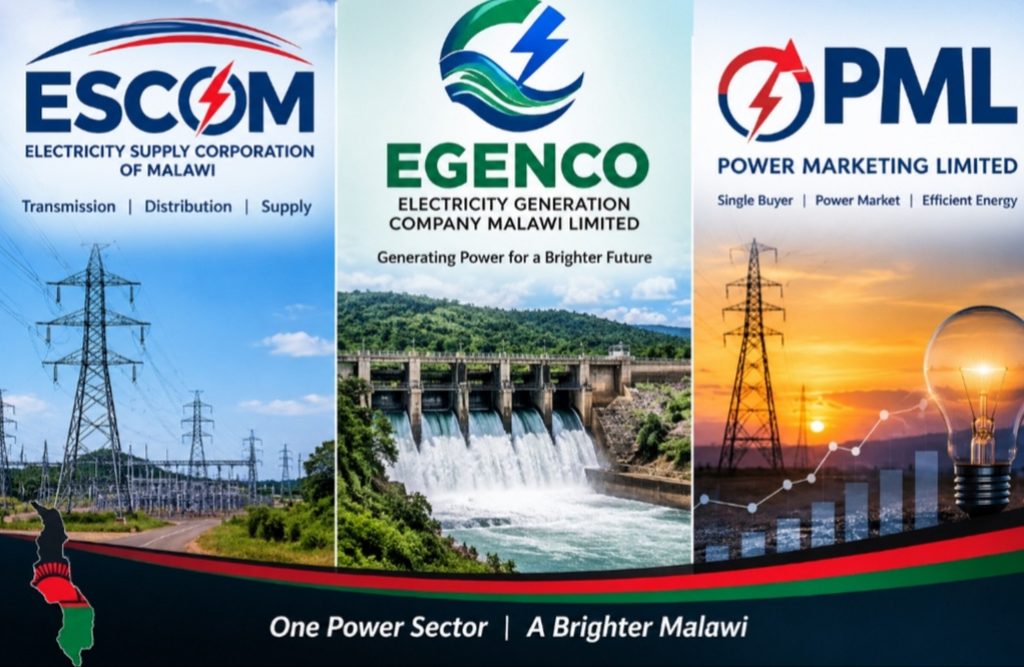
ESCOM was unbundled, and electricity generation was separated from ESCOM and transferred to a new state-owned company, the Electricity Generation Company Malawi Limited (EGENCO).
The government later established Power Market Limited (PML) to perform the role of the Single Buyer — an entity intended to purchase electricity from generators and make it available to the electricity market.
This raises a fundamental question:
Did separating ESCOM into different entities actually improve electricity supply for ordinary Malawians, or did it simply create more institutions, management structures and administrative costs without delivering reliable electricity?
WHY WAS ESCOM UNBUNDLED?
The separation of ESCOM was part of Malawi’s broader Power Sector Reform Programme.
The reforms were intended to improve efficiency, attract private investment into electricity generation and reduce dependence on a single institution.
Following amendments to the Electricity Act, ESCOM’s role became more focused on transmission and distribution, while EGENCO took responsibility for electricity generation.
The reforms were also designed to create an environment in which Independent Power Producers (IPPs) could enter the electricity market.
On paper, the objectives were clear:
- increase electricity-generation capacity;
- attract private-sector investment;
- improve efficiency;
- create a more competitive and structured electricity market; and
- reduce the risks associated with having all major electricity functions under one institution.
But the bigger question is:
To what extent have these objectives actually been achieved?
EGENCO: WHAT IS ITS ROLE?
EGENCO is not primarily responsible for distributing electricity to households.
Its main responsibility is electricity generation.
The company operates generation facilities including Nkula, Tedzani, Kapichira and Wovwe, among others.
ESCOM, meanwhile, is responsible for transmission and distribution, together with other functions within the electricity market.
Therefore, when people ask:
“Why are we still experiencing power outages if EGENCO was created to generate electricity?”
the answer cannot simply be that EGENCO alone is responsible.
Electricity shortages can be linked to several parts of the system, including generation capacity, transmission, distribution, financing, maintenance, demand and power procurement.
WHAT ABOUT POWER MARKET LIMITED?
This is another part of the story that many Malawians may not fully understand.
Power Market Limited was established as a government-owned company intended to perform the Single Buyer function.
In simple terms, the Single Buyer is responsible for purchasing electricity from generators and making sure that the electricity required by the market is procured.
However, PML did not remain in operation permanently.
According to ESCOM’s strategic planning documents, the Single Buyer licence was transferred from ESCOM to Power Market Limited in March 2020.
However, the government dissolved Power Market Limited in December 2022, and the Single Buyer function was transferred back to ESCOM.
This raises another legitimate question:
Why was Power Market Limited established in the first place, and why was it later dissolved after only a few years?
That is a question that deserves a clear public explanation.
WHAT BENEFITS WAS THE UNBUNDLING OF ESCOM SUPPOSED TO BRING?
There were several intended benefits.
First, separating generation from transmission and distribution was meant to give each function a clearer mandate and accountability structure.
EGENCO would focus on generation, while ESCOM would focus primarily on transmission and distribution.
Second, the reforms were intended to make it easier for Independent Power Producers to enter the electricity sector.
This was important because Malawi needed additional generation capacity beyond what could be provided by EGENCO alone.
Third, the reforms were intended to create clearer rules for generation, transmission, distribution, electricity procurement and market operations.
But there is another side to the story.
IF ELECTRICITY CONTINUES TO BE UNRELIABLE, WHERE IS THE BENEFIT?
This is where accountability becomes important.
Although the reforms were intended to improve efficiency and increase electricity generation, Malawi continues to experience serious electricity challenges.
EGENCO has reported technical problems affecting some of its generating units.
For example, several generating units have experienced technical faults, reduced output or maintenance challenges.
EGENCO has also pointed to difficulties in obtaining spare parts, including challenges associated with foreign-exchange availability.
This demonstrates that Malawi’s electricity crisis cannot simply be explained by saying:
“ESCOM was divided, therefore electricity problems began.”
The situation is more complicated.
It involves infrastructure, maintenance, financing, foreign exchange, ageing equipment and generation capacity.
WHO SHOULD BE HELD ACCOUNTABLE?
This is where the debate needs to become more evidence-based.
If EGENCO is responsible for generation, Malawians should be able to know:
How much electricity is EGENCO generating compared with its installed capacity?
How many generating units are currently out of service?
How much money is required to repair them?
Why are spare parts taking so long to arrive?
Why do some transformers and other critical pieces of equipment fail before they are adequately maintained or replaced?
And on the ESCOM side:
How efficiently is the available electricity being transmitted and distributed?
What condition is the transmission and distribution network in?
How much electricity is being lost through technical and commercial losses?
How are the revenues collected from electricity consumers being used to improve the network?
These questions cannot be answered by looking at one company alone.
IS MALAWI PAYING THE PRICE FOR UNBUNDLING?
Creating separate companies comes with costs.
There are boards, management teams, offices, human resources, procurement systems, accounting departments, legal services, ICT systems and other administrative structures.
Therefore, Malawians have every right to ask:
Has the money spent maintaining separate institutions resulted in more reliable electricity and increased generation capacity, or has it simply increased administrative costs?
But this question should be answered using evidence and financial data, rather than political speculation.
Government should make public the relevant annual reports, audited accounts, subsidies, government guarantees, procurement expenditure, generation costs, power-purchase costs and performance indicators of the institutions involved.
THE ELECTRICITY CRISIS DID NOT START WITH EGENCO
It is also important to put the issue into context.
EGENCO began operations in 2017, but Malawi already faced serious challenges with electricity-generation capacity.
The broader power-sector reforms were designed partly to attract new investment, including private-sector investment, so that generation capacity could expand.
Therefore, saying that “ESCOM was one company and everything worked well, then EGENCO was created and the problems started” would oversimplify a much more complex history.
However, that does not mean the reforms should be protected from scrutiny.
Every reform should ultimately be measured by its results.
If the objective was to increase generation, attract investment and improve electricity reliability, Malawians have the right to ask whether the results match the promises and objectives behind the reforms.
SO, DO WE NEED THESE COMPANIES OR NOT?
The answer should be based on performance and cost-benefit analysis, not simply on the names or number of companies.
If separating ESCOM has helped increase generation, attract new investment, improve maintenance, strengthen transparency and make electricity more reliable, then there is a clear justification for the structure.
But if institutions are consuming significant resources while failing to deliver on their mandates and consumers continue to experience prolonged power outages, then government should seriously examine what is failing and what needs to change.
The issue is not how many electricity companies Malawi has. The issue is how much reliable electricity reaches Malawians.
MALAWI NEEDS ANSWERS, NOT JUST EXPLANATIONS
The ordinary electricity consumer is not primarily interested in organisational structures.
They want to know whether they will have electricity at home.
Businesses want to know whether their machines will operate reliably.
Hospitals need dependable electricity for critical equipment.
Students need electricity to study at night.
Factories need reliable power to continue production.
And the country needs reliable electricity if it wants to attract and retain investors.
EGENCO has said it is working to restore generating units affected by technical problems.
But these commitments need to be accompanied by clear timelines, regular public reporting and measurable results.
The central question for Malawi therefore should not simply be:
“Why was ESCOM divided?”
It should also be:
“After nearly a decade of power-sector reforms, what exactly have Malawians gained?”
If the answer is increased generation, new investment, improved infrastructure and more reliable electricity, government should be able to demonstrate that through clear statistics.
If those improvements are not reflected in the experience of households, businesses and public institutions, then Malawi’s power-sector reforms deserve a serious review.
Malawi does not simply need more electricity companies. Malawi needs more reliable, affordable and accessible electricity — and institutions that are accountable to the people they are meant to serve.
— Malawi Freedom Network