

By Burnett Munthali
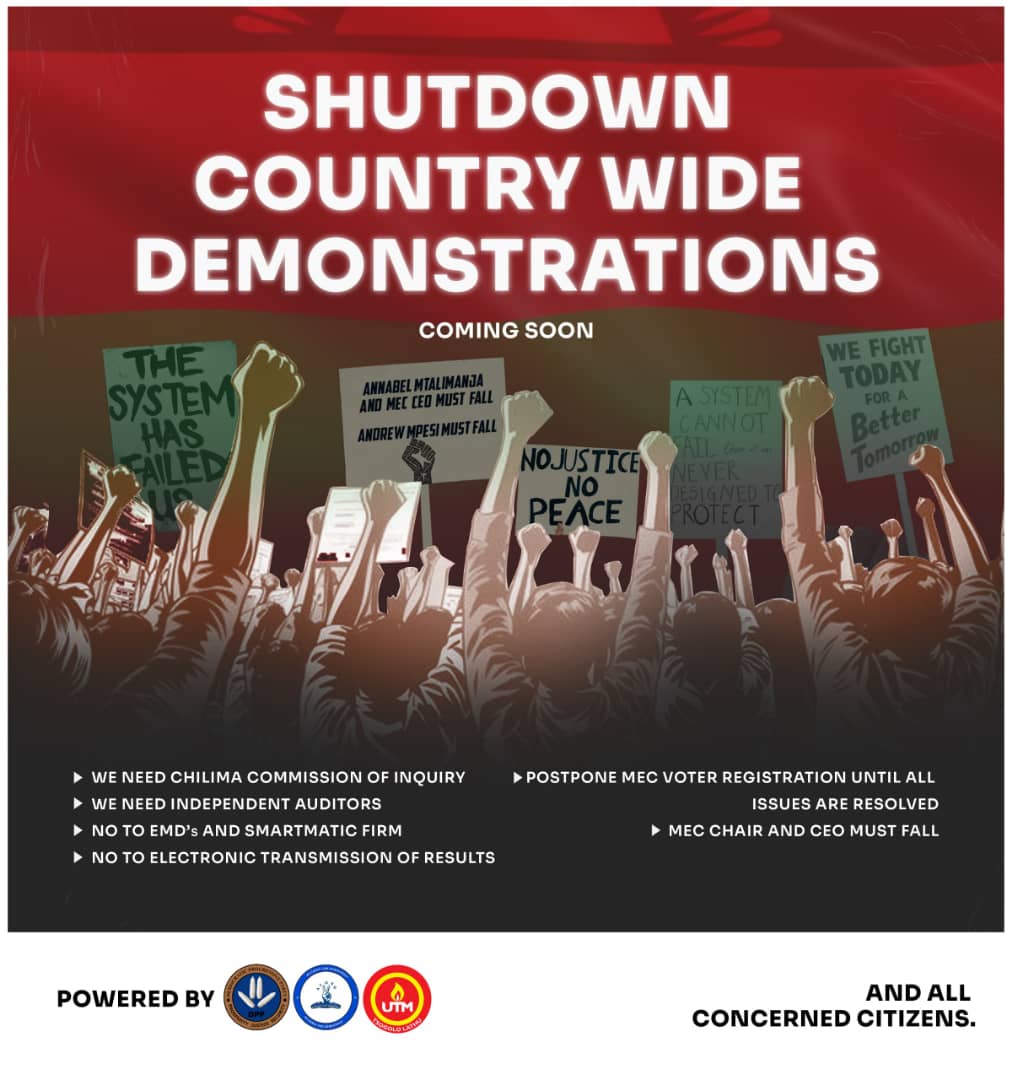
In a bold political move, three opposition parties—the Democratic Progressive Party (DPP), the Alliance for Democracy (AFORD), and the United Transformation Movement (UTM)—have teamed up with several civil society organizations to exert pressure on President Lazarus Chakwera. The coalition is demanding a thorough commission of inquiry into the circumstances surrounding the plane crash involving Vice President Saulos Chilima in Chikangawa Forest, as well as wide-ranging reforms within the Malawi Electoral Commission (MEC).
- Corporates raise K55 million for St. Pius X church project through golf tourneyShare Listen to this article By Suleman Chitera Corporate leaders and golfers have raised K55 million towards the construction of a new church at St. […]
- Government Delays Primary Teacher Diploma, Degree Programmes to 2028/29Share Listen to this article By Suleman Chitera The Government has once again postponed the introduction of diploma and degree programmes for primary school teachers, […]
- Victoria Forex Foundation Steps In With K50 Million Lifeline as Nearly 42,000 Malawians Flee South AfricaShare Listen to this article By Suleman Chitera As thousands of desperate Malawians continue streaming back home after anti-immigrant violence in South Africa, Victoria Forex […]
- OPC Debunks Viral Claims Linking South African Businessman Zunaid Moti to Malawi GovernmentShare Listen to this article By Suleman Chitera The Office of the President and Cabinet (OPC) has strongly rejected social media claims alleging that South […]
- Malawi Police Corrupt: Lawyer Demands Probe into Alleged Police Extortion of Tobacco Traders in KasunguShare Listen to this article By Staff Reporter Human rights lawyer Charles Dokera has called for an urgent investigation into allegations that police officers stationed […]
- FDH Bank, Ekhaya Group Back Gwamba’s Pakwao Concert as Excitement Builds for Ruger ShowShare Listen to this article By Suleman Chitera | Malawi Freedom Network Momentum is building ahead of one of Malawi’s biggest music events of the […]
- Power Relief in Sight? Government Promises 100MW Boost as Malawi Battles Crippling BlackoutsShare Listen to this article By Suleman Chitera Malawians enduring weeks of relentless power cuts could soon see some relief, with the government announcing that […]
- NBM plc commits K100 billion to finance Chamtulo–Golomoti roadShare Listen to this article By Suleman Chitera National Bank of Malawi (NBM) plc has committed a K100 billion loan facility to the Roads Fund […]
- Mpinganjira: I Built Blantyre Cancer Hospital to Save Lives, Not Make MoneyShare Listen to this article By Suleman Chitera Business magnate Dr. Thomson Mpinganjira has revealed that the driving force behind the establishment of the Blantyre […]
The demand for a commission of inquiry into the Chilima plane crash is at the heart of the opposition’s agenda. The crash, which shocked the nation, has raised numerous unanswered questions. While official reports have provided scant details, opposition parties suspect foul play and want a thorough, independent investigation. They believe the inquiry is critical not only to uncover the truth but also to ensure accountability at the highest levels of government. For many Malawians, the mystery surrounding the crash has lingered for too long, fueling speculation and calls for justice.
Alongside this, the opposition has turned its attention to MEC, accusing the body of incompetence and corruption. At the core of their grievances is the use of the controversial Smartmatic technology, which MEC employs for the electronic transmission of election results. Opposition parties have long raised concerns about the security and reliability of this system, fearing it could be used to manipulate results in the upcoming 2025 general elections. The opposition is demanding that MEC terminate its contract with Smartmatic and revert to a fully manual system of vote counting, which they argue is more transparent and resistant to tampering.
Furthermore, the opposition is calling for independent auditors to scrutinize MEC’s operations, suggesting that the commission may be hiding financial irregularities or inefficiencies in its management of electoral processes. By bringing in external auditors, the opposition aims to ensure greater accountability and restore public confidence in the electoral body ahead of the next elections.
In addition to these demands, the parties have called for a postponement of all voter registration activities until all issues within MEC are resolved. They argue that continuing the registration process without addressing the alleged incompetence within MEC could lead to the disenfranchisement of many voters. In particular, the opposition points to the failure of MEC to address gaps in voter registration in rural areas, which they claim disproportionately affects regions that do not traditionally support the ruling Malawi Congress Party (MCP).
Central to their demands is the immediate resignation of MEC Chairperson Justice Annabel Mtalimanja and Chief Elections Officer Andrew Mpesi. The opposition has accused both leaders of gross incompetence, alleging that they have failed to run MEC impartially and have allowed the body to be influenced by the ruling party. Calls for their resignation are seen as part of a broader effort to overhaul the leadership of MEC and ensure that future elections are managed by individuals who are not compromised.
The coalition of opposition parties and civil society organizations has vowed to escalate their actions if these demands are not met. They have issued a stern warning that “shutdown countrywide demonstrations” will be organized to force the government and MEC to comply with their requests. These planned demonstrations threaten to disrupt the nation and could potentially lead to a significant standoff between the opposition and the government in the months leading up to the 2025 elections.
In conclusion, the pressure mounting on President Chakwera and MEC is indicative of the growing tensions in Malawi’s political environment. The opposition’s call for reforms, both in the electoral commission and in the investigation of the Chilima plane crash, reflects deep-seated concerns about transparency, accountability, and the integrity of democratic processes. As the 2025 elections draw closer, these issues are likely to dominate political discourse, and the government’s response will shape the future of Malawi’s democracy.
Leave a Reply