


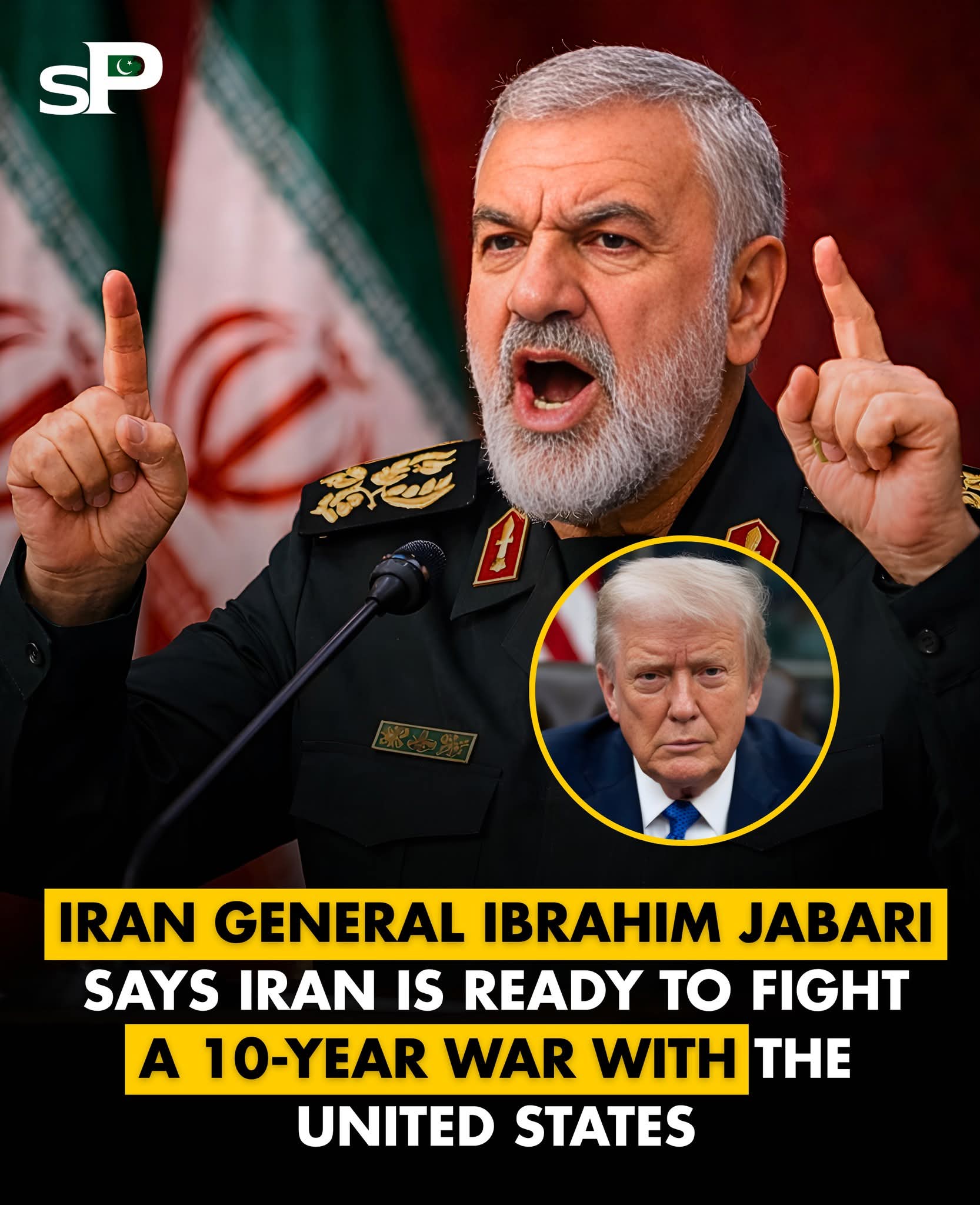
Islamic Revolutionary Guard Corps General Ibrahim Jabari Warns Iran Ready for Long War With United States
By Suleman Chitera
Tensions between Iran and the United States have taken a sharper tone after senior commander Ibrahim Jabari of the Islamic Revolutionary Guard Corps declared that Tehran is prepared for a prolonged war if confrontation with Washington escalates further.
Jabari’s remarks have drawn global attention because they signal that Iranian military leadership is not preparing for a short-term confrontation but rather a drawn-out struggle that could last many years. According to the general, Iran has developed the political will, military capacity, and economic endurance needed to withstand sustained pressure from its adversaries.
A Warning of a Long and Costly Conflict
The statement suggests that Iranian leaders believe any attempt by the United States to force rapid political change or military capitulation could instead produce a long and difficult war. By raising the possibility of a decade-long conflict, Iranian officials appear to be sending a strategic message: any direct war would likely become expensive, complex, and unpredictable for all sides involved.
Security analysts note that the message is designed to discourage escalation. Historically, Iran has relied on strategies built around endurance, asymmetric warfare, and regional alliances. Such strategies are intended to stretch conflicts over long periods, increasing costs for technologically superior opponents.
Iran’s military doctrine places heavy emphasis on resilience — the ability to continue operating despite sanctions, economic pressure, and external attacks. This approach has been shaped by decades of confrontation with Western powers, particularly since the aftermath of the Iranian Revolution.
Strategic Signaling to the World
Beyond its military implications, Jabari’s statement also appears aimed at international audiences. By openly discussing the prospect of a long war, Iranian officials are signaling that escalation could destabilize the region and global markets for years.
The Islamic Revolutionary Guard Corps has often used public statements from senior commanders to shape perceptions abroad. Analysts believe such messaging serves two key purposes: deterring adversaries and demonstrating Iran’s readiness to absorb prolonged pressure without collapsing politically or militarily.
Message to Domestic and Regional Supporters
At home and among regional allies, the remarks are seen as reassurance. Iranian leaders frequently emphasize the idea of resistance — a narrative that portrays the country as capable of surviving external threats while defending its sovereignty.
By projecting readiness for a long confrontation, commanders are attempting to reinforce public confidence and signal to allied groups across the Middle East that Tehran remains committed to its strategic posture despite mounting tensions.
Growing Global Concern
The warning comes at a time when relations between Iran and the United States remain fragile. Military incidents, political rhetoric, and regional rivalries have repeatedly brought the two nations close to direct confrontation.
Experts caution that statements like Jabari’s highlight the risk of escalation in an already volatile geopolitical environment. A direct conflict between the two powers would likely extend far beyond a conventional battlefield, potentially involving regional actors, global trade routes, and international energy markets.
For now, the message from Tehran is clear: any attempt to resolve the standoff through force could transform into a prolonged and costly struggle — one that neither side may find easy to control once it begins.
- NRFA Endorses FAM President Fleetwood Haiya
 Listen to this article By Suleman Chitera NRFA Endorses FAM President Fleetwood Haiya for Second Term Ahead of 2027 Elections The Northern Region Football Association (NRFA) has officially endorsed incumbent for a second term as president of the ahead of the association’s elections next year.EXPOSED! Allowance Scam Through Honey Trap At NRFA Speaking during the […]
 - Over 22,000 Malawians Return from South AfricaListen to this article By Suleman Chitera Over 22,000 Malawians Return from South Africa as Xenophobic Violence Forces Mass Repatriation More than 22,000 Malawians have returned home from South Africa this week after fleeing a wave of xenophobic violence, as the Malawi Government continues to coordinate a large-scale humanitarian response for those arriving at the […]
- Experts Warn Over Rising Pornography Exposure Among Malawi Youth
 Listen to this article Pornography Exposure Among Malawi Youth Sparks Alarm as Experts Warn of Mental Health and Moral Crisis By Suleman Chitera Growing exposure to pornography among young people in Malawi has become a major concern, with experts warning that the trend is contributing to mental health problems, unhealthy relationships and the erosion of […]
 - Peter Mutharika Returns to Office, New Photo Reassures Supporters After South Africa Trip
 Listen to this article By Suleman Chitera A newly released photograph showing former Malawi President Professor Peter Mutharika working from his office has reassured many Malawians who had been expressing concern about his health following his recent visit to South Africa.Atupele Muluzi clarifies his remarks as not an insult to Mutharika Speculation over Mutharika’s health […]
 - Malawi Government Releases K5 Billion to Repatriate Citizens Fleeing Xenophobic Violence in South Africa
 Listen to this article By Suleman Chitera The Malawi Government has released K5 billion to the Department of Disaster Management Affairs (DoDMA) to support the ongoing repatriation of Malawians fleeing xenophobic violence in South Africa. DoDMA Commissioner Wilson Moleni said the funds, provided by the Ministry of Finance, will help facilitate the safe return of […]
 - Press Corporation Expands Global Investments as 2025 Profit Surges to K261 Billion
 Listen to this article Press Corporation Limited says it will continue expanding locally and internationally after posting a record K261 billion profit in 2025, with new investments in oil, gas, and export trade. By Suleman Chitera Business conglomerate Press Corporation Limited (PCL) has reaffirmed its commitment to expanding its investment portfolio both within Malawi and […]
 - NBS Bank Scraps SME Banking, Unveils Bold Business Banking Strategy to Help Build Malawi’s Next Business Giants
 Listen to this article By Staff Reporter NBS Bank has unveiled one of the biggest strategic transformations in its history, abandoning its traditional Small and Medium Enterprise (SME) Banking model in favour of a comprehensive Business Banking strategy that promises to fundamentally change how businesses are financed, supported and grown in Malawi. Rather than simply […]
 - MDF former Commandant calls to an end of conspiracy theories on Chilima’s death
 Listen to this article By Vincent Gunde Malawi Defence Force (MDF) Chief, Policy, Strategy and Plans and former Commandant of the National Defence College – Malawi Brigadier General Professor Dan Kuwali, has appealed to the Parliamentary Adhoc Committee to find a way of stopping conspiracy theories by people spreading rumours or allegations that some individuals […]
 - Imran Jumbe Calls for South Africa to Compensate Malawians Affected by Xenophobic Violence
 Listen to this article By Suleman Chitera Imran Jumbe Calls for South Africa to Compensate Malawians Affected by Xenophobic Violence, Urges National Unity Ahead of July 30 Protest Rights activist Imran Jumbe has called on the South African government to compensate Malawians who were forced to flee the country following repeated incidents of xenophobic violence, […]
 - Will The Dream Of Bingu To Construct Nsanje Inland Port Be Fulfilled?
 Listen to this article By Mabvuto Kalawa, Correspondent, Malawi News Network The late President Professor Bingu wa Mutharika, may his soul rest in peace, envisioned a Malawi that was developed and self-reliant. During his tenure, Malawi recorded abundant food production and even exported rice to Haiti. In 2006, the Food and Agriculture Organization, FAO, recognized […]
 - NBM plc delivers potable water to Mikate Health Post in Thyolo
 Listen to this article By Suleman Chitera National Bank of Malawi (NBM) plc has handed over a newly constructed solar-powered water reticulation system to Mikate Health Post in Thyolo, aimed to improve healthcare service delivery. The donation forms part of the bank’s district council’s K200 million Corporate Social Responsibility (CSR) initiative supporting various development initiatives […]
 - NBM plc rewards 20 customers in third ‘Waku WAFCON’ POS promo
 Listen to this article By Suleman Chitera National Bank of Malawi (NBM) plc rewarded 20 customers with Malawi National Women’s Football Team jerseys during the third draw of its Waku WAFCON POS Promotion held at the bank’s Capital City Service Centre in Lilongwe. The winners walked away with official Scorchers jerseys after correctly participating in […]
 - Reserve Bank Earns US$74 Million from Gold Sales, Easing Forex and Fuel ShortagesListen to this article By Our Reporter The Reserve Bank of Malawi (RBM) has earned US$74 million (approximately K128 billion) from the sale of 600 kilograms of gold, a move that is helping to ease the country’s foreign exchange challenges.Why Are Malawi Cabinet Ministers Silent on Alleged “Gold Shipment to Israel”? Public Demands Answers Grow […]
- TNM Launches Music Star Search: K120 Million Prize and Car
 Listen to this article By Our Reporter TNM Launches Music Star Search: K120 Million Prize and Car to Transform Malawi’s Creative Industry TNM PLC has officially entered the entertainment space with the launch of its Music Star Search, a nationwide talent platform aimed at discovering and nurturing Malawi’s next generation of musical stars. The initiative, […]
 - FDH Bank Commits K100 Billion to Golomoti–Mangochi Road as William Mpinganjira Says Project Will Transform Malawi Tourism
 Listen to this article FDH Bank has reaffirmed its commitment to supporting Malawi’s national development after committing K100 billion towards the rehabilitation of the Golomoti–Mangochi Road, a strategic infrastructure project expected to improve transport, stimulate tourism, and strengthen economic growth. Speaking during the official launch of the road construction project on Thursday, FDH Bank Chief […]
 - Mzuzu City Hammers Coach Chisomo Kamulanje Blames Lack of Confidence for Poor National Division League FormListen to this article By Suleman Chitera Mzuzu City Hammers Coach Chisomo Kamulanje Blames Lack of Confidence for Poor National Division League Form Mzuzu City Hammers head coach Chisomo Kamulanje has attributed his side’s inconsistent start to the NBS Bank National Division League season to a lack of confidence among his players following their relegation […]
- Senegal Crash Out of 2026 World CupListen to this article By Staff Reporter Senegal Crash Out of 2026 World Cup After Dramatic 3-2 Extra-Time Defeat to Belgium Senegal’s 2026 FIFA World Cup campaign came to a heartbreaking end after a dramatic 3-2 defeat to Belgium in a Round of 16 clash played at Lumen Field in Washington, United States. The West […]