

 Malawi Freedom Network
 By Malawi Freedom Network
Concerned Citizens of Malawi–People Power Movement says private litigation must not be used to paralyse Parliament’s constitutional oversight role
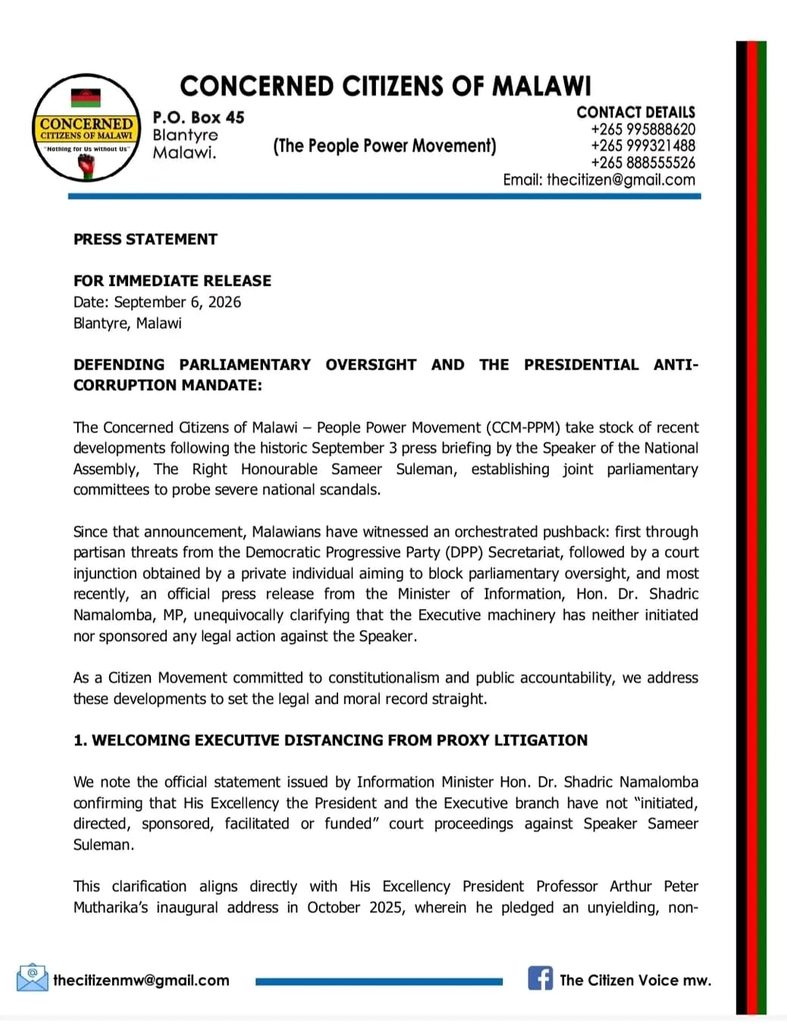
The Concerned Citizens of Malawi–People Power Movement (CCM-PPM) has launched a forceful challenge against an injunction obtained by an individual seeking to stop Parliament from probing selected state entities, warning that the court action risks undermining constitutional accountability and creating a dangerous precedent for Malawi’s democracy.
In a strongly worded statement dated 6 September 2026, the pressure group has asked the courts to vacate the injunction and allow Parliament to proceed with its investigations, arguing that the legislature must be protected from attempts to frustrate or silence its oversight mandate.
The statement, signed by Edwards Kambanje, Oliver Nakoma and Prince Mataka, calls on the judiciary to uphold the doctrine of separation of powers and reject what the group describes as attempts by private individuals to weaponise civil litigation against Parliament.
‘DON’T GAG PARLIAMENT’
CCM-PPM says Malawi cannot afford a situation where parliamentary investigations into matters of public interest can be halted simply because an individual has gone to court.
“Malawi cannot afford a system where public accountability is blocked whenever an investigation touches sensitive nerve centres,” the group says.
According to CCM-PPM, Parliament exists not merely to debate legislation but also to scrutinise the conduct of public institutions, demand explanations from state officials and investigate matters that affect the public interest.
The group therefore argues that any attempt to prevent parliamentary committees from carrying out such duties must be subjected to serious constitutional scrutiny.
“Parliament is built to protect the people and the President vowed to spare no corrupt actor,” the statement says.
CCM-PPM BACKS SPEAKER
The group has also thrown its weight behind the office of the Speaker of Parliament, insisting that the Speaker and lawmakers should be allowed to discharge their constitutional responsibilities without intimidation or unnecessary legal obstruction.
“We stand firmly with the office of the Speaker and the Legislature in fulfilling their constitutional oversight duties in defence of national interest,” CCM-PPM declares.
The group, led by Kambanje, maintains that Parliament should be given sufficient space to conduct all joint committee inquiries into public institutions where questions surrounding accountability, governance or the use of public resources have arisen.
It says parliamentary oversight is a critical component of democratic governance and should not be weakened whenever investigations become politically or institutionally uncomfortable.
‘WHO IS AFRAID OF PARLIAMENTARY SCRUTINY?’
The controversy surrounding the injunction has raised a broader question about the limits of court intervention in parliamentary affairs.
CCM-PPM argues that courts must be cautious not to inadvertently create a situation where individuals can routinely obtain injunctions that interfere with Parliament’s constitutional functions.
The organisation says allowing such a practice to continue could effectively give private litigants a mechanism to suspend parliamentary accountability whenever they disagree with an inquiry.
For CCM-PPM, that would represent a serious threat to democratic checks and balances.
The organisation insists that Parliament must be able to investigate institutions in the public interest while respecting the Constitution and the law.
ACCOUNTABILITY ‘CANNOT BE NEGOTIATED’
The group says the issue goes beyond the individuals involved in the current legal dispute.
According to CCM-PPM, the central question is whether Malawi wants strong institutions capable of holding public authorities accountable or a system where investigations can be stalled through litigation.
It argues that public institutions manage resources and exercise powers on behalf of Malawians and should therefore remain subject to scrutiny.
The organisation has consequently urged the courts to consider the wider constitutional implications of maintaining the injunction.
It says the judiciary should protect the constitutional architecture of the country rather than allow civil proceedings to become a tool for paralysing another arm of government.
A TEST FOR MALAWI’S DEMOCRACY
CCM-PPM describes the dispute as an important test of Malawi’s commitment to the separation of powers.
The legislature, executive and judiciary have distinct constitutional responsibilities, and the group argues that none of the three arms should be allowed to unlawfully dominate or disable another.
At the same time, CCM-PPM’s position does not mean Parliament should operate above the law.
Rather, the group says parliamentary investigations should proceed within the Constitution while courts retain their legitimate role in determining questions of legality and constitutional compliance.
The organisation is particularly concerned that an overly broad injunction could have the practical effect of stopping Parliament from exercising functions expressly entrusted to it.
CALL FOR PARLIAMENT TO STAND FIRM
CCM-PPM has urged the Speaker and members of Parliament not to retreat from their oversight responsibilities because of legal pressure.
The group says Malawians expect Parliament to scrutinise state institutions, expose weaknesses in public administration and demand answers where public interest is at stake.
It further argues that parliamentary committees should be allowed to follow evidence wherever it leads, provided they remain within their constitutional mandate.
For CCM-PPM, the fight is therefore not simply about one injunction or one parliamentary investigation.
It is about whether public accountability will remain enforceable when powerful or sensitive institutions come under scrutiny.
The organisation has consequently called on the courts to vacate the injunction and allow Parliament’s joint committees to continue their inquiries.
THE BIGGER POLITICAL BATTLE
The confrontation places renewed attention on the relationship between Parliament and the courts, particularly where judicial proceedings have the potential to affect parliamentary oversight.
CCM-PPM’s intervention adds political pressure to an already sensitive constitutional debate.
Its message is uncompromising: Parliament must not be gagged, public accountability must not be paralysed, and civil litigation must not become a shortcut for stopping legitimate scrutiny of state institutions.
As the legal battle unfolds, attention will now focus on how the courts respond to the group’s demand and whether Parliament will be allowed to proceed with the contested inquiries.
For CCM-PPM, however, the position is already clear: Malawi’s accountability institutions must be allowed to do their job—and nobody should be allowed to place Parliament under a judicial muzzle without a compelling constitutional basis.