
 Malawi Freedom Network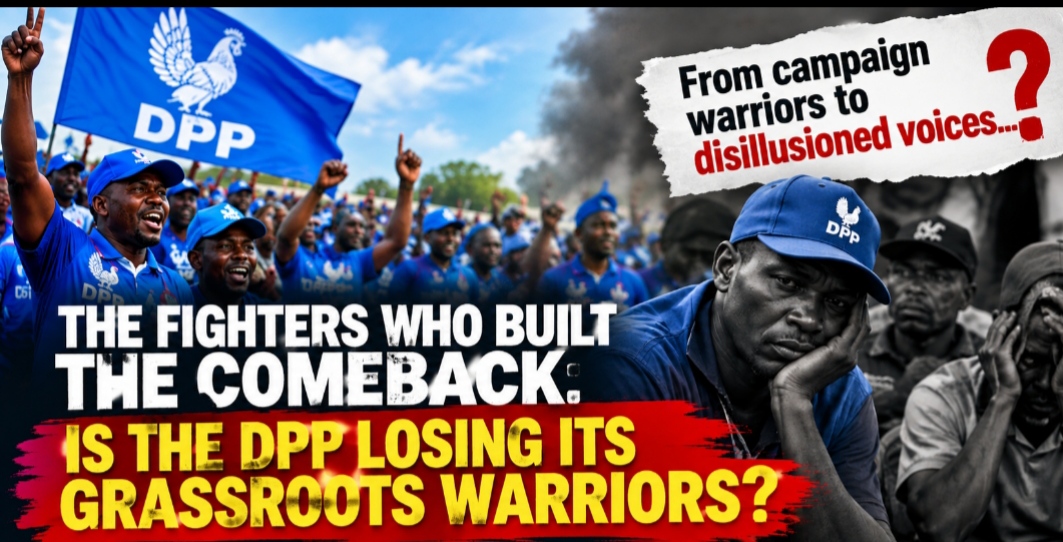
ByOur Reporter
Malawi Freedom Network | September 21, 2026
The battle for power may have been won, but a new battle is quietly unfolding within the political trenches of the Democratic Progressive Party (DPP): what happens to the people who fought for the party when it had no government to offer them?
That question is becoming increasingly difficult to ignore.
As the DPP marks one year since Professor Arthur Peter Mutharika’s return to State House, allegations are emerging that some of the activists, commentators and grassroots voices who relentlessly defended the party during its years in opposition now feel forgotten.
The claims have been pushed into the public domain by MCP supporter Rodgers Kamphangala, who argues that some of the people who helped create the political momentum behind Mutharika’s 2025 comeback are now struggling for recognition.
His argument is blunt: the people who fought the political war from the trenches should not become invisible once victory has been declared.
They fought when government was elsewhere
For years, the DPP was outside government.
Political activists had to operate without the machinery and resources associated with being the governing party. Social-media commentators, online broadcasters, journalists and grassroots mobilisers became important voices in a political environment dominated by the governing MCP administration.
Kamphangala has singled out several personalities whom he says remained vocal in supporting Mutharika and the DPP, including Bakili Muluzi TV, Comrade Ntanyiwa, Bon Kalindo, Pastor Moses Shumba, Bishop W. Kachenje, Suleman Chitera, Vincent Gunde and Jones Gadama, among others.
His central claim is that some of these individuals made personal sacrifices during the campaign period and helped sustain the political message that eventually propelled the DPP back into government.
Whether every individual named shares that assessment is not independently established.
But the broader question is legitimate: what recognition does a political party owe its grassroots machinery after an election victory?
The victory did not happen in a vacuum
Mutharika’s return to State House was decisive.
The September 16, 2025 presidential election gave him 56.75 percent of the valid vote, according to the final results reported by the Malawi Electoral Commission.
But elections are not won by candidates alone.
Behind every political comeback are thousands of conversations, Facebook posts, rallies, community meetings, campaign messages, arguments, political programmes and ordinary supporters who carry a party’s message into places its leadership cannot reach.
That invisible political machinery can be particularly powerful when a party is in opposition.
And that is precisely why the current complaints deserve attention.
The uncomfortable question: who gets remembered?
Political parties routinely celebrate election victories.
Leaders appear on podiums. Ministers are appointed. Parliamentarians take office. New alliances emerge. Government institutions begin operating under a new administration.
But campaign volunteers and political activists do not automatically enter government.
That creates a difficult gap between political contribution and political reward.
Kamphangala alleges that some DPP-linked activists now believe they were important when the party needed their voices but became less important after power was secured.
That allegation has not been independently verified, and it should not be interpreted as evidence that every DPP activist feels abandoned.
But if even a significant section of the grassroots genuinely feels disconnected, the issue could become politically important.
From megaphones to silence?
The strongest political movements are rarely built only inside party offices.
They are built in communities.
They are built by people who argue for their party in markets, villages, workplaces, social-media groups, radio programmes and family conversations.
They are built by people willing to defend a political cause when doing so carries no immediate personal benefit.
According to Kamphangala, some of those voices are now asking what became of the relationship they expected to have with the party after victory.
That creates an uncomfortable contrast.
During opposition, grassroots activists can be treated as the party’s political engine.
After victory, the same activists can find themselves outside the formal structures of government.
Recognition is not the same as a job
There is an important distinction here.
Supporting a political party does not automatically create an entitlement to a government position, diplomatic appointment, parastatal job or financial reward.
Government appointments are subject to legal, institutional and political considerations.
But recognition is different.
A political party can acknowledge the contribution of volunteers without promising them public positions.
It can listen to their concerns.
It can maintain communication with its grassroots structures.
It can recognise people who worked tirelessly during difficult political periods.
That distinction sits at the heart of the current controversy.
The danger of creating a forgotten army
A governing party cannot afford to think only about those who occupy offices.
Its political strength ultimately rests on its relationship with ordinary supporters.
If people who spent years defending a party begin publicly saying they have been forgotten, the issue becomes bigger than individual disappointment.
It becomes a question of political organisation.
It becomes a question of loyalty.
And eventually, it becomes a question of whether the party’s leadership is still communicating effectively with the people who helped carry its message.
The DPP has publicly emphasised party unity and discipline, while its leadership has also stressed the importance of recognised party structures.
That makes grassroots engagement even more relevant.
The battle for 2030 starts long before 2030
There is another reality that political parties cannot escape.
The next election cycle does not begin when campaign posters go up.
It begins when supporters start deciding whether they still believe in the political project they once defended.
Kamphangala has already linked the frustrations he describes to the next electoral cycle, arguing that those who feel ignored today will remember their experiences tomorrow.
That is a claim about political sentiment, not an established prediction of future electoral behaviour.
But it highlights a fundamental reality: political loyalty is not something a party can simply assume.
It has to be maintained.
The DPP’s real challenge
The DPP does not face the question of whether its activists deserve automatic government positions.
It faces a more basic question:
Does the party still know how to value, communicate with and organise the grassroots voices that helped carry its political message when it was in opposition?
That question cannot be answered by slogans.
It requires engagement.
It requires listening.
And, perhaps most importantly, it requires the party to distinguish between people seeking personal rewards and genuine grassroots supporters who simply want their contribution acknowledged.
For the people who stood in the political trenches before September 2025, the message from the current debate is unmistakable:
Do not remember the campaign warriors only when the next campaign begins.
The DPP won the battle for State House.
Now comes the harder task of maintaining the political coalition that made that victory possible.
And if the voices coming from the grassroots are growing louder, dismissing them may be far easier than answering them—but it will not make the questions disappear.