 Suleman Chitera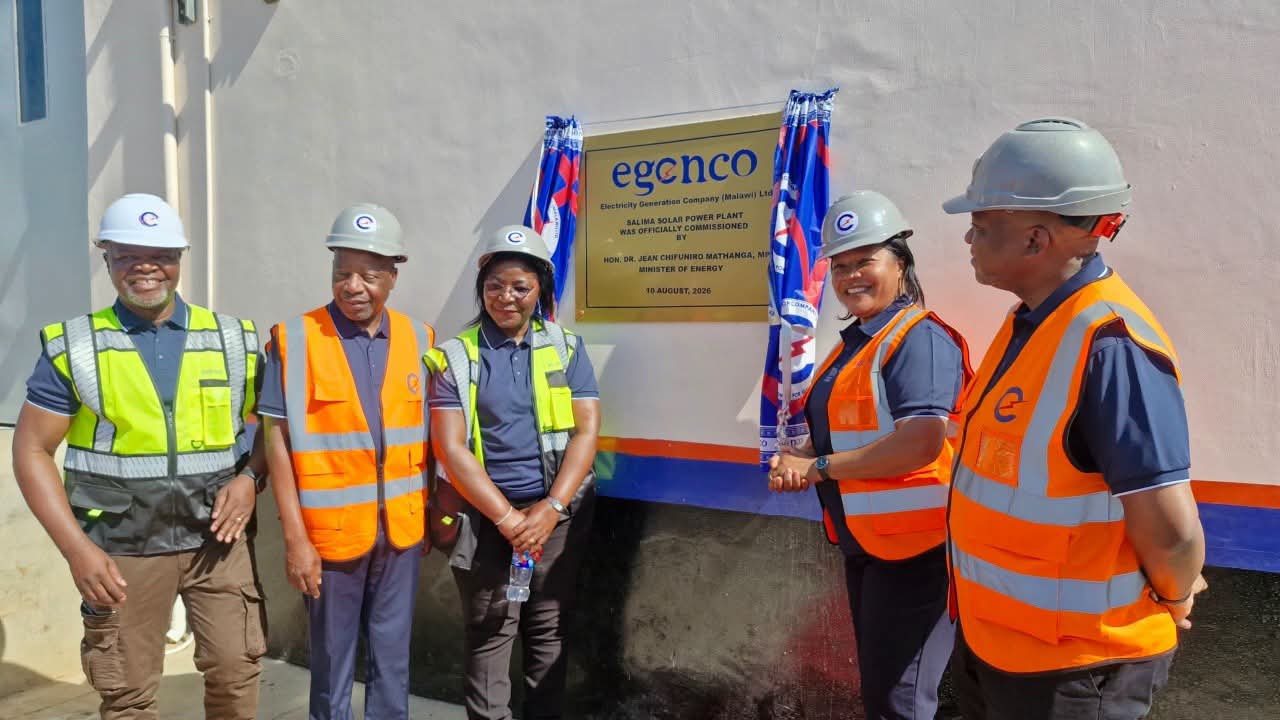
By Suleman Chitera
SALIMA — The Malawi Government says it is accelerating investment in electricity generation and transmission projects as it moves to address the country’s persistent power shortages and meet growing electricity demand.
Minister of Energy Jean Mathanga said government would “leave no stone unturned” in expanding electricity generation capacity and ensuring that more Malawians and businesses have access to reliable power.
Mathanga was speaking on Monday in Salima when she commissioned the first 10 megawatts (MW) phase of the EGENCO Salima-Nanjoka Solar PV Power Plant, a project expected to contribute to Malawi’s electricity supply.
The minister said the solar project forms part of a broader government strategy to diversify electricity generation and reduce pressure on the country’s power system.Escom CEO redeployed
Salima solar project to reach 50MW capacity
According to Mathanga, the Salima-Nanjoka solar power plant has a total planned capacity of 50MW, with the next phase expected to add another 30MW.
The expansion will bring the plant closer to its full planned capacity and further increase the contribution of solar energy to Malawi’s national electricity generation mix.
Mathanga said government was also pursuing several other major power projects across the country as part of efforts to close the electricity supply gap.
Among the projects is the Mpatamanga Hydropower Project, which is expected to generate 358MW when completed.
The minister said six additional electricity projects are also in the pipeline, with two projects earmarked for each of Malawi’s three regions.
“We will leave no stone unturned to meet the electricity demand in the country,” Mathanga said.
Malawi to access 50MW through Southern African Power PoolEGENCO Accuse ESCOM On Payments
Mathanga also disclosed that Malawi is preparing to join the Southern African Power Pool (SAPP) through an interconnection with Mozambique.
She said the arrangement is expected to allow Malawi to access an additional 50MW of electricity in the coming weeks.
“Just to remind you, we will be joining the Southern Africa Power Pool through Mozambique. We will get 50 megawatts in a matter of weeks,” she said.
The planned electricity imports are expected to provide additional support to Malawi’s power system as the country continues implementing projects aimed at increasing domestic generation.
Malawi has been pursuing a combination of solar, hydro and regional power-interconnection projects to improve electricity availability and strengthen the reliability of the national grid.
EGENCO says solar project faced delays
Electricity Generation Company of Malawi Limited (EGENCO) Chief Executive Officer William Liabunya described the commissioning of the Salima project as a milestone for the company and the country.ESCOM, Police Engage Lumbadzi Chiefs in Fight Against Vandalism
Liabunya said the project dates back to 2018 but encountered a number of challenges that affected its progress.
He said the commissioning of the first phase therefore represented an important step towards completing the wider project and increasing electricity generation capacity.
The development is also expected to strengthen Malawi’s transition towards a more diversified energy mix by increasing the role of solar power alongside traditional hydropower generation.
Salima hails government development projects
Salima District Council Chairperson Adams Fazili welcomed the commissioning of the solar project, saying it demonstrated government’s continued investment in infrastructure in the district.
Fazili said Salima was benefiting from various development projects in sectors including education, agriculture and sports, in addition to energy infrastructure.
The commissioning of the solar plant comes as Malawi continues to face increasing demand for electricity driven by population growth, industrialisation, businesses and expanding access to electricity.EGENCO says blackouts to end by September 22, 2022.
Government’s planned investments in new generation capacity, coupled with regional power imports, are expected to play a critical role in improving electricity supply and supporting economic activity.
What the Salima solar project means for Malawi
The expansion of electricity generation is considered critical to Malawi’s economic development because reliable power is needed to support industries, businesses, agriculture, health facilities, schools and digital services.
The government’s electricity strategy is therefore increasingly focusing on solar power, hydropower and regional electricity interconnections to increase supply and improve the resilience of the national grid.
Read also: Admarc Hires New CEO