
 Suleman Chitera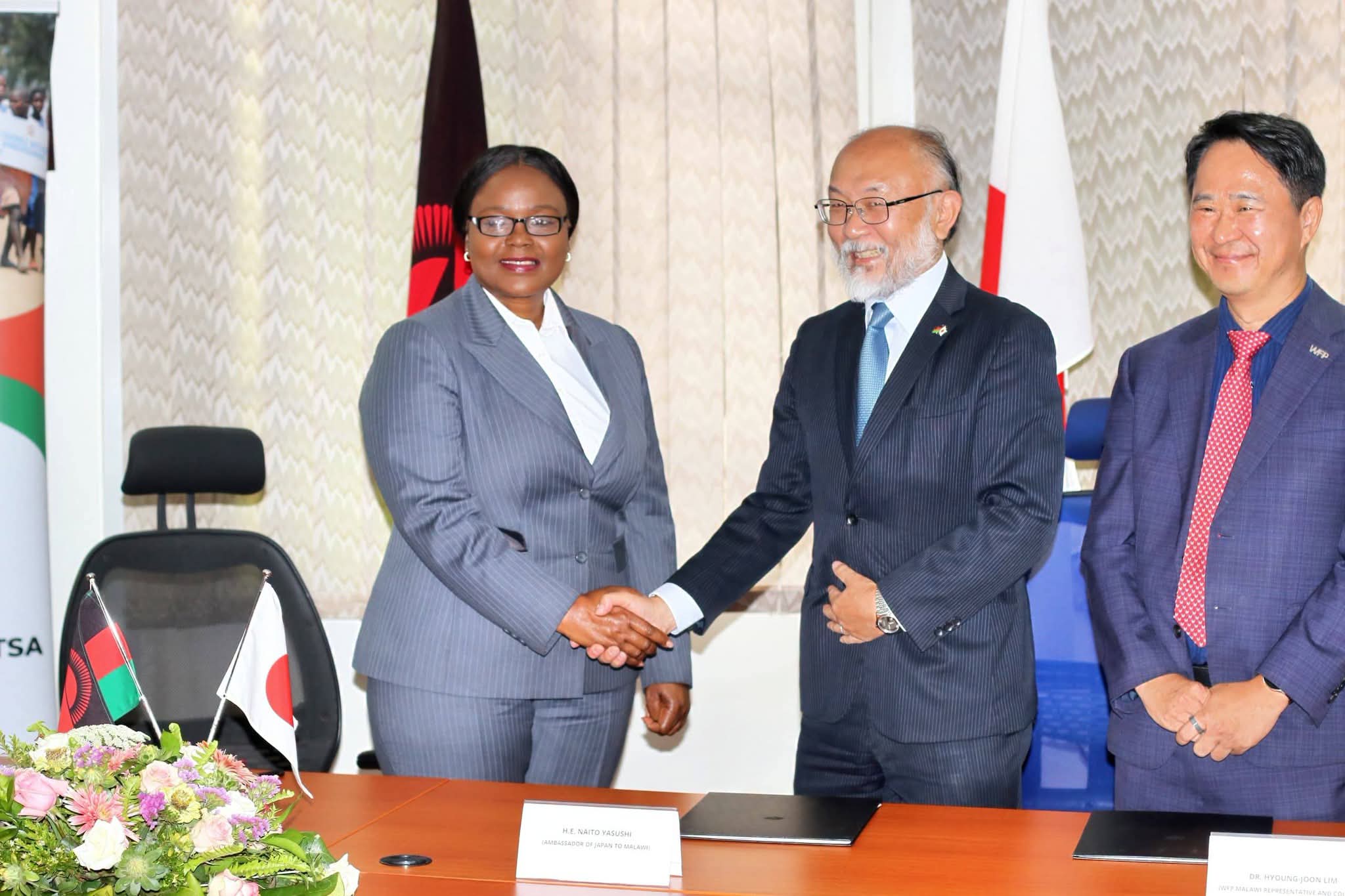
By Suleman Chitera
LILONGWE, Malawi — The Government of Japan has committed US$1.9 million (approximately K3.3 billion) through the United Nations World Food Programme (WFP) to support Malawi’s 2026/27 Lean Season Response Programme, with the funding earmarked for the procurement and pre-positioning of rice for vulnerable communities.
The contribution is expected to strengthen Malawi’s preparedness for food insecurity during the lean season, a period when many households face increased pressure as food stocks decline before the next harvest.
The agreement was signed during a Food Aid agreement ceremony held at the WFP offices in Lilongwe, bringing together representatives of the Malawi Government, the Government of Japan and WFP.
Speaking at the ceremony, Minister of Agriculture, Irrigation and Water Development Roza Fatch Mbilizi described Japan’s contribution as a timely and strategic intervention that would help the country prepare for anticipated food assistance needs before they become more critical.
“By procuring and pre-positioning food in advance, we can respond more quickly and effectively when needs arise,” said Mbilizi.
She said food security and the achievement of Zero Hunger remain among Government’s key priorities, but Malawi continues to face serious challenges from climate-related shocks that repeatedly disrupt agricultural production and livelihoods.
According to the Minister, droughts, floods, cyclones and prolonged dry spells have increasingly affected farming communities, reducing agricultural output and putting additional pressure on already vulnerable households.
Mbilizi also warned that the anticipated impacts associated with El Niño could further complicate the food security situation, making early preparedness and coordinated response increasingly important.
She said Government was therefore implementing a range of measures aimed at strengthening the country’s resilience, including climate-smart agriculture, expansion of irrigation, promotion of drought-tolerant crops, improved early warning systems and strengthened disaster preparedness and response mechanisms.
Japan steps up food security support
Japanese Ambassador to Malawi, His Excellency Naito Yasushi, reaffirmed Japan’s commitment to supporting Malawi’s efforts to strengthen food security and build resilient communities.
The Ambassador said the assistance would provide food support to approximately 170,000 vulnerable Malawians during the coming lean season.
Japan’s latest contribution adds to its longstanding cooperation with Malawi across several sectors, including agriculture, food security, infrastructure, health, education and disaster preparedness.
Mbilizi commended the Government of Japan for its continued support, saying such partnerships were important as Malawi works to protect vulnerable communities from the effects of recurrent shocks.
She also praised WFP for its continued collaboration with the Malawi Government, particularly its expertise in food procurement, logistics and humanitarian response.
WFP to procure 1,910 metric tonnes of rice
WFP Country Director and Representative Hyoung-Joon Lim said the Japanese funding would be used to procure 1,910 metric tonnes of rice for the 2026/27 Lean Season Response Programme.
The programme is being implemented in partnership with the Malawi Government and development partners, with the food expected to be pre-positioned ahead of the period when vulnerable households are likely to face heightened food shortages.
Lim said the intervention comes at a critical time, with Malawi already experiencing significant levels of food insecurity.
He said more than 1.9 million people are currently facing crisis-level food insecurity, while the number is projected to increase to more than 2.6 million people between October and March.
The projected increase highlights the importance of early procurement and positioning of food supplies before demand reaches its peak.
Why pre-positioning matters
For humanitarian agencies, securing food supplies in advance is critical in countries where climate shocks, infrastructure constraints and seasonal shortages can make emergency procurement and distribution more difficult.
By purchasing and positioning rice before the peak of the lean season, WFP and its partners can reduce delays in delivering assistance to communities once food insecurity intensifies.
The approach also allows humanitarian actors to plan transportation, storage and distribution more effectively while ensuring that food stocks are available closer to communities that need assistance.
For Malawi, where agriculture remains heavily dependent on rainfall, the effects of poor harvests can extend well beyond the farming season, affecting household food supplies, incomes and access to essential services.
Climate shocks continue to threaten food security
The latest intervention comes against a backdrop of repeated climate-related shocks affecting Malawi’s agricultural sector.
Droughts and prolonged dry spells can reduce crop yields and livestock productivity, while floods and cyclones can destroy crops, homes, roads and other critical infrastructure.
Such shocks can leave rural households with depleted food stocks and limited purchasing power, increasing their dependence on humanitarian assistance.
The Government’s emphasis on irrigation, climate-smart agriculture and drought-tolerant crops is therefore aimed not only at responding to immediate food shortages but also at reducing the vulnerability of communities to future climate shocks.
Government, Japan and WFP strengthen partnership
The agreement demonstrates continued cooperation between the Malawi Government, Japan and WFP in addressing food insecurity and strengthening humanitarian preparedness.
While emergency food assistance remains essential for households facing acute shortages, the broader strategy is increasingly focused on building resilience and reducing the impact of recurring shocks.
The Japanese-funded rice procurement is expected to form part of this wider response by ensuring that food stocks are available when the lean season reaches its most difficult period.
With more than two million people potentially requiring assistance during the coming months, the Government and its partners face a significant challenge in ensuring that support reaches the most vulnerable communities efficiently and on time.
The US$1.9 million Japanese contribution, therefore, represents more than an immediate food assistance package. It is also an investment in early preparedness, humanitarian response capacity and Malawi’s efforts to protect vulnerable households from the worsening effects of food insecurity and climate-related shocks.
As the 2026/27 lean season approaches, authorities and humanitarian partners are expected to continue strengthening early action, food procurement, coordination and community-level preparedness to ensure that assistance reaches those most at risk.
Read also: Corrupt Mafia Batatawala Case Commence On 25 April 2022
Read also: Prof. Peter Mutharika declares readiness to lead Malawi again
Read also: CAMA Demands MACRA to Reverse Airtel and TNM Data Tariff Hikes Over Alleged Legal Violations