
 Suleman Chitera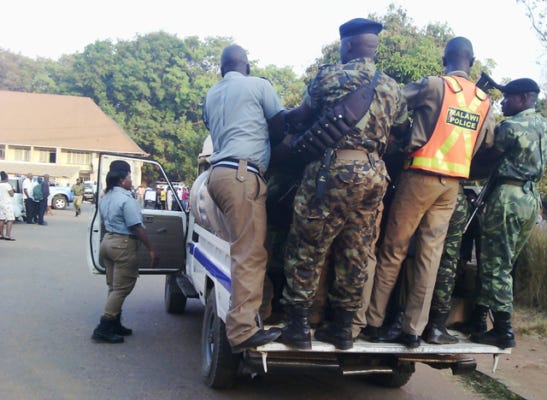
By Suleman Chitera
In every democracy, there is a fundamental principle that should never be compromised: a citizen must be able to speak, question those in power and demand accountability without fearing that the machinery of the State will be turned against them.
Yet whenever police powers are allegedly used to intimidate, harass or silence vocal citizens, an important question must be asked: Are public institutions being used to protect the people, or are they being used to protect political interests?
This is not a question about supporting one political party against another. It is a question about the kind of country Malawians want to build.
The police are entrusted with enormous power. They can arrest, investigate, detain and restrict a person’s freedom. That power exists because society expects the police to protect citizens and enforce the law fairly. It should never become a tool for settling political disagreements, punishing criticism or frightening people into silence.
The danger of silencing the voices of ordinary people
Poor and vulnerable citizens often have very little access to political power. They may not have influential connections, expensive lawyers, powerful media platforms or direct access to decision-makers.
For many of them, their greatest weapon is their voice.
When a farmer complains about the price of inputs, when a young person questions unemployment, when a community challenges poor service delivery, or when a citizen demands transparency over public resources, that person is exercising a democratic right.
Such criticism may sometimes be uncomfortable. It may even be harsh.
But democracy was never designed to protect only opinions that are convenient to those in power.
A government that is confident in its record should be prepared to answer difficult questions. A government that believes it is serving the people should not need intimidation to defend itself.
Police must enforce the law—not political interests
There is an important distinction between legitimate law enforcement and political intimidation.
If a citizen commits a genuine offence, the police have a duty to investigate. Nobody should be above the law, including politicians, activists, journalists or ordinary citizens.
But the law must be applied consistently.
A person’s political views, criticism of government or support for poor communities should not, by itself, make that person a criminal.
The real test of a democratic police service is not how it treats people who agree with those in power. The real test is how it treats people who disagree.
When citizens begin to believe that speaking openly could result in police harassment, arrest or intimidation, the damage extends far beyond one individual.
Other people become afraid to speak.
Journalists become cautious.
Activists become silent.
Community leaders stop raising concerns.
Whistleblowers keep information to themselves.
Eventually, an entire society begins to censor itself.
That is how democratic space gradually disappears—not necessarily through one dramatic event, but through the repeated intimidation of people who dare to speak.
Parliament has a responsibility
This is where Parliament must play a decisive role.
Members of Parliament are not elected merely to approve budgets, debate political parties or pass ordinary legislation. They are also custodians of democracy and representatives of the people.
Parliament should continuously examine whether existing laws and institutional safeguards are strong enough to prevent the abuse of police powers.
There should be clear safeguards against the use of law enforcement agencies for political retaliation.
Police decisions should be based on law, evidence and professional judgment—not instructions designed to punish political critics.
Where allegations of political interference arise, there should be credible mechanisms for independent investigation and accountability.
Citizens who believe they have been unlawfully targeted should have accessible avenues for seeking justice.
And officers who knowingly participate in unlawful intimidation should not be protected simply because the person who allegedly influenced the action is politically powerful.
Political leaders must understand the power they control
Politicians should remember that government institutions do not belong to them personally.
The police belong to the people.
Public offices belong to the people.
The Constitution belongs to the people.
Government resources belong to the people.
A politician who is in power today may be in opposition tomorrow. The laws and institutions created today will remain long after individual politicians have left office.
Therefore, leaders should be extremely careful about creating or tolerating practices that could later be used against them or their supporters.
The same police powers that can be used against today’s critic can eventually be used against tomorrow’s government supporter.
When political leaders weaken institutional safeguards, they do not only endanger their opponents—they endanger democracy itself.
The poor should not pay the price for political power struggles
Perhaps the most painful consequence of political intimidation is that it can silence the very people who need representation most.
A wealthy citizen may have lawyers, connections and resources to challenge an abuse of power.
A poor citizen may have none of these.
For that person, speaking publicly may be the only way to attract attention to a problem.
If that voice is silenced through fear, who will speak about the broken road in the village?
Who will speak about a hospital without medicine?
Who will question corruption?
Who will demand jobs for young people?
Who will defend farmers struggling with rising costs?
Who will ask where public money has gone?
The poorest citizens depend on brave voices to bring their struggles into the national conversation.
Silencing those voices does not merely silence individuals. It can silence entire communities.
Criticism should not be treated as an enemy of government
A mature democracy understands that criticism can actually strengthen government.
When citizens point out failures, leaders have an opportunity to correct them.
When journalists investigate problems, government can respond.
When activists demand accountability, institutions can improve.
When opposition politicians challenge government decisions, the public gets an opportunity to hear different perspectives.
This is the purpose of democratic checks and balances.
The objective should not be to create a country where nobody criticises government.
The objective should be to create a country where criticism can happen peacefully, responsibly and without fear.
Parliament should consider stronger safeguards
Malawi’s lawmakers should consider whether additional legal and institutional safeguards are necessary to prevent political interference in policing.
Such reforms could include stronger protections for police operational independence, clearer rules governing political direction of law-enforcement activities, stronger oversight mechanisms and transparent procedures for investigating complaints of police abuse.
Parliament could also examine whether citizens have sufficient protection when they expose suspected wrongdoing or raise legitimate concerns about government institutions.
Any reform should preserve the legitimate powers of the police to investigate crime while preventing those powers from being manipulated for political purposes.
This is not about making the police powerless.
It is about making them professional, accountable and independent enough to enforce the law without fear or favour.
The country must reject a culture of fear
Malawi cannot build a strong democracy if citizens are afraid to speak.
Development requires participation.
Accountability requires questioning.
Justice requires people who are willing to expose wrongdoing.
And democracy requires citizens who can challenge those in power.
A country where everyone is afraid to speak may appear peaceful on the surface, but beneath that silence can be frustration, injustice and hopelessness.
True peace is not the absence of criticism.
True peace is a society where people can disagree without being persecuted.
A call to political leaders
Political leaders across the political divide should make a commitment that no citizen will be targeted simply for exercising legitimate democratic rights.
Those in government should resist the temptation to use state institutions against their critics.
Those in opposition should also reject the practice of using political influence to intimidate opponents whenever they gain access to power.
The principle must apply to everyone.
Today it may be an opposition supporter.
Tomorrow it may be a government supporter.
Today it may be an activist.
Tomorrow it may be a journalist.
Today it may be a community leader.
Tomorrow it could be an ordinary farmer demanding accountability.
The protection must therefore be institutional, not political.
The Malawi we should build
Malawi deserves institutions that are stronger than individual politicians.
It deserves police officers who can look every citizen in the eye and say: We serve the law, not a political party.
It deserves politicians who can tolerate criticism.
It deserves Parliamentarians who will defend the constitutional rights of citizens even when doing so is politically inconvenient.
And it deserves citizens who can stand up for the poor without worrying that their courage will make them targets.
The solution is not to weaken law enforcement.
The solution is to ensure that law enforcement cannot be misused.
The solution is not to protect criminals from investigation.
The solution is to ensure that legitimate investigations are never confused with political punishment.
And the solution is not to silence criticism.
The solution is to answer criticism with facts, transparency and better governance.
Malawi’s democracy will ultimately be judged not by how it treats those who praise those in power, but by how it treats those who challenge them.
The time has come for a serious national conversation about strengthening safeguards against political interference in law enforcement.
Because when a citizen can no longer speak for the poor without fear, the problem is bigger than that citizen.
It becomes a problem for democracy itself.
And Parliament, political leaders, the police, civil society and citizens must work together to ensure that the power of the State is never turned into a weapon against the very people it was created to protect.