
 Malawi Freedom Network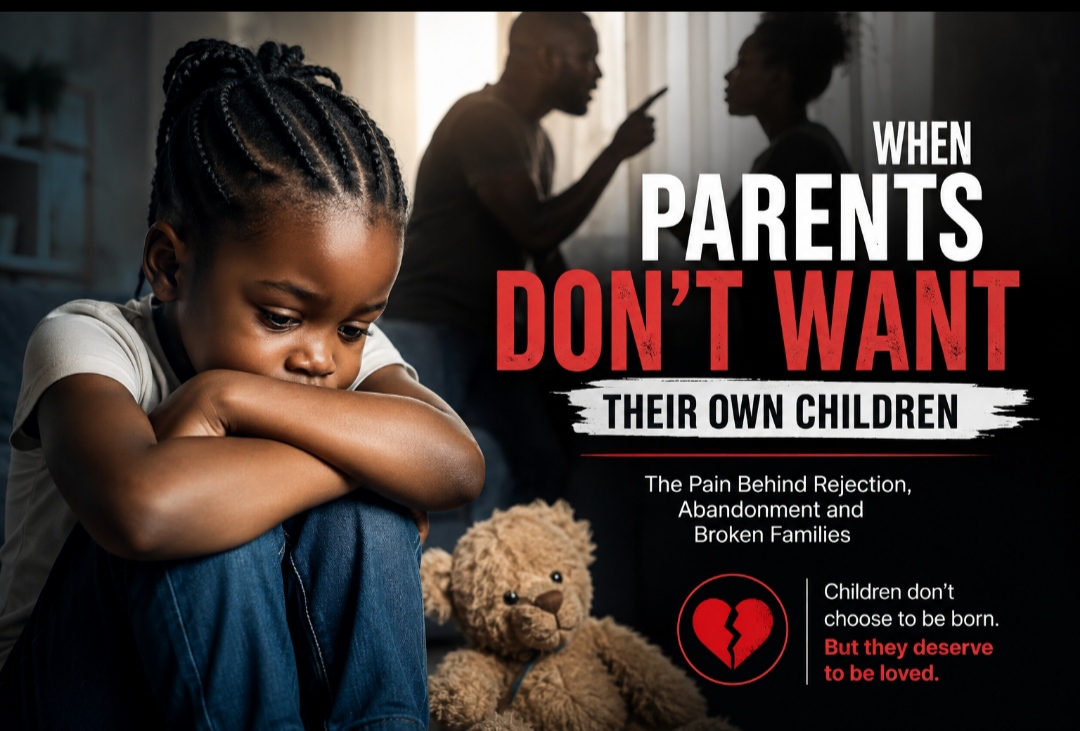
By Our Reporter
There are few wounds more painful for a child than growing up knowing—or feeling—that the very people who were supposed to love and protect them did not want them.
For many children, home is expected to be a place of safety, acceptance and unconditional love. Yet, behind closed doors, some children are growing up with rejection, neglect and emotional distance from their own parents.
In some cases, parents openly tell their children that they were unwanted. In others, rejection takes more subtle forms—constant criticism, favouritism, neglect, abandonment or treating one child as less important than the others.
The consequences can be devastating.
A child who repeatedly hears that they are unwanted may begin to question their own worth. They may grow up believing that they are a burden, that they are not good enough or that they do not deserve love.
When children become victims of circumstances they did not choose
Children do not choose to be born.
They do not choose the circumstances surrounding their birth, their parents’ relationship, their family’s financial situation or the problems that may exist between adults.
Yet, some children are made to carry the emotional burden of decisions they had no control over.
A pregnancy may have been unexpected. A relationship may have broken down. Parents may have married under difficult circumstances. Financial pressures may have become overwhelming.
But none of these circumstances should make a child feel responsible for their existence.
Whatever difficulties adults face, children deserve dignity, protection, care and affection.
The danger of parental rejection
Parental rejection can leave scars that are not immediately visible.
A child who constantly feels unwanted may become withdrawn, develop low self-esteem or struggle to trust others. Some may seek acceptance from people who exploit their vulnerability simply because they desperately want to feel loved.
As they grow older, these experiences can influence friendships, relationships, education and their ability to build healthy families of their own.
This is why parental rejection should not be dismissed as simply a “family matter.”
It is an issue that can affect a child’s entire life.
Some parents may also be struggling
While children must never be blamed for adult problems, it is also important to recognise that some parents themselves may be dealing with difficult circumstances.
Poverty, domestic conflict, separation, unemployment, substance abuse, social pressure and unresolved personal trauma can affect parenting.
This does not excuse abuse, abandonment or deliberate rejection.
Instead, it highlights the need for families to receive support before problems become irreversible.
Parents who are struggling need access to counselling, parenting support, community networks and social services. Asking for help should not be viewed as weakness.
Every child deserves to hear: “You are wanted.”
A child should not have to earn the right to be loved.
They should not have to compete with siblings for affection.
They should not have to become perfect students, successful adults or financially useful family members before they are treated with dignity.
Children need reassurance that their existence has value.
Sometimes, a simple sentence such as “I love you,” “I am proud of you,” or “You are important to me” can make an enormous difference in a child’s life.
Families and communities have a role to play
Protecting children cannot be left entirely to individual families.
Teachers, religious leaders, community organisations, social workers, relatives and other trusted adults can play an important role in identifying children who are experiencing neglect or emotional abuse.
When a child repeatedly shows signs of distress, isolation or fear, adults should not automatically assume that the child is simply being difficult.
Sometimes, difficult behaviour is a cry for help.
The answer should not always be punishment. Sometimes, the child needs someone to listen.
A message to parents
Being a parent is not only about providing food, clothing and school fees.
It is also about providing emotional security.
Parents may make mistakes. They may become frustrated. They may struggle financially or emotionally. But children should never be made to believe that they are unwanted because of circumstances beyond their control.
Every child deserves the opportunity to grow up knowing that they matter.
And when a parent is unable to provide that love and care, society must be willing to step in—not to replace the family unnecessarily, but to protect the child from being left alone with pain they did not create.
Because children should never have to spend their childhood asking one heartbreaking question:
“Why didn’t my own parents want me?”